"Jews light 44 candles or oil ampules over the eight days of hanukkah. How guilty are we of climate change, according to the lying Climategate scientists at East Anglia University?" ~ Yasha Harari
Fresh Baked Goods
Laughzilla the Third (2012)
The Third Volume in the Funny Stuff Cartoon Book Collection Available Now.
Japan is gearing up to impose regulations on the bitcoin cryptocurrency, according to a report from local business paper Nikkei Asian Review.
With the new rules, Japanese citizens would be taxed for bitcoin purchases and the protocol would be treated as a commodity, similar to gold, rather than an actual currency.
Governments have been unsure of how to handle bitcoin as it grows in popularity. Japan emerges as one of the first to take direct steps to control the currency.
The news comes just days after Mt. Gox, a high-profile bitcoin exchange based in Tokyo, shut down after losing a massive 750,000 bitcoins due to an alleged bug.
Overstock.com has surpassed $1 million in sales generated from Bitcoin transactions. The retailer partnered with Coinbase on January 9 to let consumers purchase items with the digital currency, meaning the milestone was achieved in less than two months.
As you can see in the charts above shared by Coinbase, more than 4,000 customers made purchases with Bitcoin on Overstock.com in some 50 days. The average order size for a Bitcoin customer ($226) was 34 percent greater compared to customers paying in USD ($168), and over half of all customers paying in Bitcoin were new to Overstock.com (58 percent), having never purchased goods from the site before. Those are impressive results, but the real test will be to see how those numbers hold up.
One month after Microsoft announced Satya Nadella as its new CEO, predecessor Steve Ballmer made an appearance at the Saïd Business School, part of England’s Oxford University, where he discussed many things with his long-time friend Professor Peter Tufano, who’s now Dean of the School.
As we noted earlier, Ballmer wasn’t short on advice for fledgling startups and budding entrepreneurs, but when prodded by Tufano specifically on the issue of failure and success – not only in startups but large corporations – he had some words of wisdom to share with the world.
“If you look at things in the past ten years, I think it’s probably fair to say there are things that did not go as well as we intended to,” says Ballmer. “We’d have a stronger position in the phone market if I could redo the last ten years. And yet one of the things you say to yourself is, ‘do you give up?’ There’s a whole ethos and culture and rhetoric around startups, that I think is wrong.”
This rhetoric, according to Ballmer, is that startups should succeed quickly and fail fast. “I actually think that what really great companies do, is they don’t fail fast,” he explains. “They may modify their ideas, they may see that their core proposition needs to change, but it’s a great team of people that’s fired up and found a really fertile area, and you just keep working it until you get it to be absolutely successful.”
Of course, Ballmer acknowledges that this isn’t always how things turn out – money runs out, you fail and the world still spins around. But from his own experience at Microsoft, persistence is key.
“Our job isn’t to give up and go home,” he says. “It’s to try and continue the initiative, and catch the next wave of rapid innovation. Take the world ten years from now, do you think we’ll use devices that look anything like the devices that we have here today?”
Whether it’s Google Glass or Google ear-muffs, devices certainly will be different a decade from now, and it’s this that was pivotal to his point that if you’re behind in an area just now, you just try and catch them up at the next opportunity. Though perhaps in Microsoft’s case, it has yet to do that in many respects – particularly with smartphones. But that’s not to say that it can’t and won’t reclaim any market that it has lost.
There are lessons to be learned here for younger companies too, with Ballmer noting that patience, adaptability and tenacity are key attributes for people looking to make waves in the startup realm.
“Microsoft was launched in 1975, but I wouldn’t say we hit the big-time until some time in the mid-to-late nineties,” explains Ballmer.
“Google was started in ’97-ish, I would say they hit the big time probably ten years later,” he continues. “Facebook’s ten-years-old, they’ll make over a billion dollars this year, and that’s pretty good. But that’s ten years – that’s not, ‘Oh, we fell out of bed, and then we were successful five minutes later. SAP was at things twenty years before they were successful, Oracle was at things fifteen years. And while things are somewhat faster today, the notion of taking a long-term point-of-view is the number one thing missing in most companies – big, small or startup.”
The Lifesaver Case is a new crowdfunding project that is building an iPhone case that you can use to secretly send out an emergency alert with your location if you’re ever in danger.
The polycarbonate case includes a slider button on the side that, when activated, will place an Enhanced 911 and send your location, identifying information, and microphone and video camera input to authorities. An LED light will activate to let you know that a request for help has been sent, but the app runs discreetly in the background, so your attacker won’t know that you’ve activated it.
Early bird backers on Indiegogo can pick up a case for $59, but it will retail for $99 when it goes on sale. The Lifesaver case is compatible with the iPhone 4 and later, and it’s scheduled to begin shipping in August.
Creator John Powell set out to build the Lifesaver after a terrifying experience where a man tried to abduct his daughter on her way to school. Several non-profit groups, including The National Coalition Against Domestic Violence, Veterans For Missing And Exploited Children, and The National Network to End Domestic Violence, have endorsed the device.
With attachments like the Yellow Jacket stun gun iPhone case and the Lifesaver coming to market, inventors are getting serious about how to use our phones to keep us safe. Hopefully, you and your loved ones won’t ever have to activate the Lifesaver Case, but it’s still worth it just for the peace of mind.
This post originally appeared on the Buffer blog and is republished with permission.
I’ve written how creativity works in the brain before, and I found it really useful to understand this process. Or, I should say, multiple processes.
There’s so much going on in the brain during creativity that science is still trying to pin down exactly how it all works.
What we do know is which three parts of the brain work together to help us create and come up with new ideas:
The Attentional Control Network helps us with laser focus on a particular task. It’s the one that we activate when we need to concentrate on complicated problems or pay attention to a task like reading or listening to a talk.
The Imagination Network as you might have guessed, is used for things like imagining future scenarios and remembering things that happened in the past. This network helps us to construct mental images when we’re engaged in these activities.
The Attentional Flexibility Network has the important role of monitoring what’s going on around us, as well as inside our brains, and switching between the Imagination Network and Attentional Control for us.
You can see the Attentional Control Network (in green) and the Imagination Network (in red) in the image below.
Understanding how important connections are to creativity has also made a difference to how I try to generate new ideas. Once we have a lot of knowledge, we need to spend time making connections between it all—this is where creativity comes in.
I’ve shared some ideas in my previous post about creativity to help you come up with new ideas, such as putting yourself in challenging situations, criticizing your own ideas and being open to having lots of (bad) ideas in order to find just a few great ones—something Seth Godin is a fan of:
Someone asked me where I get all my good ideas, explaining that it takes him a month or two to come up with one and I seem to have more than that. I asked him how many bad ideas he has every month. He paused and said, “none.”
These tips are handy, but I’ve found that my environment makes a big difference to how productive I am, and how easily I can brainstorm new, creative ideas.
It turns out, environmental factors like noise levels, temperature and lighting can make a big difference to how creative we are. Here’s what the research says about setting up your environment for optimal levels of creativity.
Sound — ambient noise levels are best for creativity
Far from blasting music through out headphones, it turns out that a moderate noise level is the sweet spot for creativity. Ambient noise gets our creative juices flowing unlike silence, and doesn’t put us off the way high levels of noise do.
Here’s how it works: moderate noise levels increase processing difficulty which promotes abstract processing, leading to higher creativity. Or, in other words, when we struggle just enough to process things as we normally would, we resort to more creative approaches.
In high noise levels, our creative thinking is impaired because we’re overwhelmed and struggle to process information efficiently. I know I’ve felt this when it’s lunchtime in my co-working space, or my neighbors are renovating their apartment while I’m trying to work.
Another study about ambient noise showed that when it comes to being distracted by the conversations of others, phone calls where we can only hear one side of the conversation are the worst offenders.
After a survey showed that up to 82 percent of people find overhearing cellphone conversations annoying, Veronica Galván, a cognitive psychologist at the University of San Diego, looked into why these are so distracting.
In the study, participants completed puzzles while they overheard either one side of a mundane phone conversation or an entire conversation as it took place between two people in the room.
Those who heard the one-sided phone conversation found it more distracting than those who heard both people speaking. They also remembered more of the conversation, showing that it had grabbed their attention.
So if you’re heading to a co-working space, open office or coffee shop to get some work done, keep in mind that phone conversations will dampen your creativity.
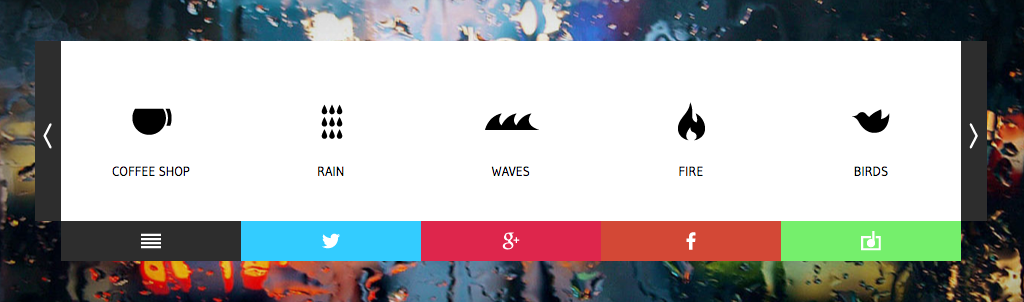
In case your local coffee shop doesn’t have the optimal level of noise to get your creative juices flowing, there are a few tools available to bring that ambient café sound to your desk:
A study from Cornell University tested different office temperatures at a large Florida insurance company and found the following:
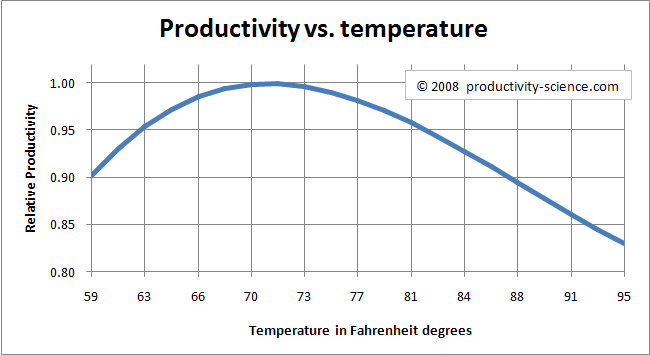
When temperatures were low (68 degrees or 20 degrees Celsius) employees made 44% more mistakes than at optimal room temperature (77 degrees or 25 degrees Celsius).
The problem isn’t just being uncomfortable in cold temperatures, but rather that you are more distracted. If you are feeling cold, you are using a substantial amount of your energy to simply keep warm.
Thus, a lot less energy goes towards concentration on creative work.
Increasing the temperature in your office, adding more clothing layers or bringing a portable heater to work could make all the difference when it comes to increasing your creativity. Be careful not to make it too warm though, as being hot decreases productivity as much as being cold does:
Lighting — turn down the lights for more creativity
An important point to remember when you’re optimizing for creativity is that the process of creative work goes through different stages. When I’m editing a blog post, for instance, I’m less worried about generating creative ideas than I am when I’m brainstorming topics or mapping out the structure of a post.
So optimizing your environment could call for different situations depending on the phase of work—e.g. remember how I mentioned earlier than silence is best for concentration?
When it comes to lighting, keeping the lights down low can be beneficial for generating creative ideas, though you might want to adjust the brightness when you need to focus at a later stage of your work! This infographic from PayScale has some tips on lighting for productivity:
Research published in the Journal of Environmental Psychology looked at the difference in creativity levels in brightly-lit and dimly-lit environments over six studies.
The research found that dim lighting helps us to feel less constrained and free to explore and take risks. Two of the studies tested this feeling in particular, and found that “darkness elicits a feeling of being free from constraints and triggers a risky, explorative processing style.”
So when you’re gearing up for a brainstorming session, try turning down the lights before you get started.
Space — keep a separate, messy desk
One of my favorite talks about creativity is this one by John Cleese. I can’t think of many people more suited to speaking on this topic, and he doesn’t disappoint.
One of the main points John makes is that your creativity is like a tortoise: It pokes its head out nervously to ensure the environment is safe before it fully emerges. Your creativity won’t show up when you’re nervous or stressed, busy or surrounded by hustle and bustle. It’s a very particular kind of thinking.
John says to help your “tortoise mind” emerge, you need to create an oasis for it, amongst the craziness of modern life, where it feels safe:
You can’t become playful, and therefore creative, if you’re under your usual pressures.
Removing yourself from your normal work environment—i.e. your “busy” space—to a free, creative space sends a signal to your brain. And if you do this consistently, your tortoise brain will learn to recognize the place as a safety zone for creative thinking.
If you can, add the suggestions of optimal temperature, lighting and noise levels to your creative space, and do your “busy work” elsewhere.