"WikiLeaks has done what even Al-Qaida couldn't do: Reveal Muammar Ghaddafi's true ambition: To always be escorted by a buxom blonde nurse everywhere he goes." ~ Yasha Harari
Fresh Baked Goods
Laughzilla the Third (2012)
The Third Volume in the Funny Stuff Cartoon Book Collection Available Now.
Apple today launched iTunes Radio in Australia, its first market outside of the United States. The streaming service, built into the Music app pre-installed on all iOS devices, will give listeners access to over 100 stations.
Unlike Spotify, Rdio and Deezer, iTunes Radio isn’t an on-demand music streaming service. It’s free and ad-supported, putting it against other internet radio services such as Pandora and Last.fm. If you’re a subscriber to iTunes Match – which current costs $34.99 in Australia – the ads are stripped out and you’ll be able to listen uninterrupted.
Inside the Music app on iOS 7, Apple shows a list of Featured Stations curated by its own staff, as well a list of radio stations that you’ve set up yourself. Tap once and a playlist is built, which you can listen to and share with friends. Apple is hoping the service will also be a gateway back into its iTunes store, which rose to prominence alongside the iPod. When listeners discover new music that they like, they can either tag it for future reference, ask for “more like this” or purchase it directly from iTunes.
iTunes Radio was announced in June last year for iOS 7, Apple TV, Mac and PC. Apple says its streaming service will get smarter over time, learning from your listening habits and personal collection on iTunes. The firm also promises exclusive music “before you hear them anywhere else” via its First Play initiative, which should give iTunes Radio a small edge over its rivals.
Apple’s presence in the music streaming market can’t be understated, but it’s notable that the company hasn’t opted for an on-demand, subscription-based service similar to Microsoft with Xbox Music and Google with All Access. Nevertheless, it’ll be interesting to see how Apple developers iTunes Radio over the coming months and years.
Apple is also rumored to be launching the service in the UK, Canada and New Zealand in the early part of this year.
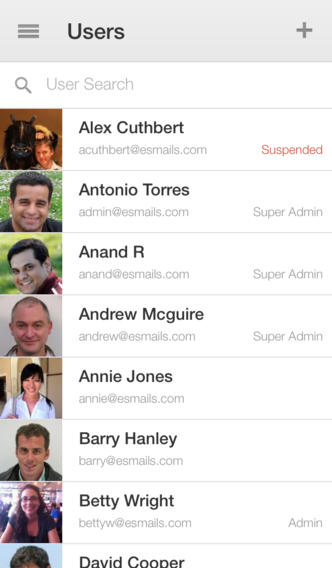
Google has quietly released an iOS version of its mobile app for managing its Google Apps enterprise product.
The app allows super admins of Google Apps domains to manage individual users, adjust group settings and review audit logs. It’s designed to work with business, education, government, Google Coordinate and Chromebook accounts.
Google launched the Android version of its Google Admin app last May.
Hulu has inked a new deal with CBS to bring more of the U.S. broadcaster’s programming to Hulu Plus, its subscription-based TV and movie streaming service.
The deal adds 2,600 new episodes to Hulu’s library, covering classic TV shows such as The Brady Brunch, Melrose Place, and Taxi, as well as more recent programming such as Everybody Loves Raymond, Undercover Boss, United States of Tara and Ghost Whisperer.
The fresh content nearly doubles the 2,700 CBS episodes that were added to Hulu’s catalog in November 2012, giving new and existing Hulu Plus subscribers access to over 5,300 instalments in total. The previous deal brought across arguably more high-profile titles including Star Trek, The Good Wife, CSI: Miami, Numb3rs and Sabrina the Teenage Witch.
Today’s announcement is a non-exclusive, multi-year agreement and follows a separate deal last week that gives Hulu exclusive subscription video-on-demand rights for the Sherlock Holmes-based drama ‘Elementary’.
Groupon has today released its first self-service Deal Builder, which allows businesses to put together Groupon package deals for themselves.
Since launching back in 2008, local businesses that wanted to run a Groupon offer have needed to coordinate these campaigns with Groupon itself. However, according to today’s announcement, this will be a thing of the past – at least, if the business involved is happy to do it all themselves.
The new Deal Builder (found at GrouponWorks.com) guides merchants through the step-by-step process of building their own deals and allows them to choose from a selection of different deal templates.
From today, the Deal Builder is available to “almost all” local businesses in the US following a successful trial period with 10,000 businesses, the company said.
Mikael Cho is the co-founder of ooomf, a network that connects short-term software projects with handpicked developers and designers. Mikael writes about psychology, startups, and product marketing over on the ooomf blog.
Damn. I forgot my headphones.
Nothing has a more negative impact on my day than showing up to our office without them.
Like most people, music is a huge part of my life and my tastes are constantly changing based on how I feel or what I’m doing.
I listen to the most music while I work, sifting through playlists, from jazz, to indie pop, to electronica, on what seems to be a never-ending search for the perfect tunes to keep me in the zone.
When I looked back at all my favorite playlists, I wondered what effect music has had on my work and more specifically, which types of music have had the most impact.
I thought it’d be interesting to take a dive into the science behind the deep power of music to find out if it actually helps you work better.
Why you love music
Whether you’re listening to the driving beat of a Daft Punk song or the opening chords of a mellow Jack Johnson track, both have an effect on your brain that is not seen in any other animal.
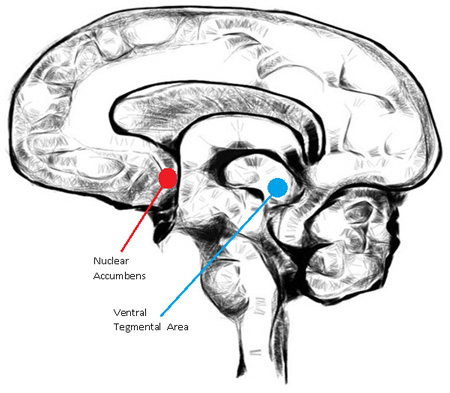
When you listen to music, a part of your brain called the nucleus accumbens activates. This triggers the release of the ‘pleasure chemical’ dopamine, that lives in a group of neurons in your brain called the Ventral Tegmental Area (VTA):
This pathway in the brain is called the Reward System and Dopamine is strongly associated with it.
Dopamine is the same chemical that gets released when you eat your favorite food or when you get a new follower on Twitter, causing you to want more, more, more.
This is why Dopamine is also responsible for the saying:
The amount of dopamine that gets released and the feelings of pleasure we get from it are also largely dependent on the element of surprise.
For instance, when you stumble upon a new song that you love, more dopamine is released and you get even more excited than if you were to listen to one of your favorite songs that you’ve heard multiple times.
Music was meant to keep you alive
From the perspective of evolution, there’s something deeper about why you feel pleasure when you listen to music.
Neuroscientist and musician Jamshed Bharucha noted that creative domains, like music, allow humans to connect in a synchronized way, helping us develop a group identity and makes us more likely to work together – which was an immensely important advantage for keeping the human species alive.
This development of group identity through music was seen in a recent study of preschool children.
The study paired children together in sets of two and showed them toy frogs. The researchers said these toy frogs needed to be woken up by either a song or exercise.
Psychologists then split the children up into two groups of 24 sets of children.
One group sang a song as they walked around a collection of toy frogs while the other group walked (or crawled) around a separate set of frogs without any music:
Afterwards, the children were presented with tubes filled with marbles. When the children were given their tubes, the bottoms would fall out, causing the marbles to fall on the floor.
The researchers noted if the two children paired together would help each other to pick up the marbles.
The results of the study showed that children who sang the song together, were more cooperative in helping to clean up the marbles.
The researchers concluded that music may have evolved as a way of fostering a sense of community and developing immediate empathetic concern.
Music’s power is deeply rooted in our brains and developed out of a need to empathize, create harmony, and more importantly, survive.
Does listening to music actually make you better at your job?
Music has a powerful relationship to our primal need of connecting with others, so how does this translate over to listening to music while you work?
Music helps you finish boring tasks faster
If you’re not looking forward to cleaning out your email after getting back from a vacation or filling out that nasty excel spreadsheet at the end of the month with your finances, music can help.
Because listening to music you like is pleasurable, it will not only make the task seem more fun but as research shows, it can actually help you complete the task faster.
In a study published in the journal of Neuroscience of Behavior and Physiology, it was found that a person’s ability to recognize images, letters, and numbers was faster when rock or classical music was playing in the background compared to when there was no music.
A similar effect was noted when workers on an assembly line listened to music. The workers who listened to music were more happy and efficient and made fewer errors.
So whatever type of music you like, as long as you’re listening to something, you’ll enjoy repetitive or boring tasks more and get them done faster.
Press pause when learning something new
When you’re presented with new information that’s complicated, it takes more focus and mental energy for you to grasp and apply that knowledge.
For instance, if you’re learning how to drive a stick shift car or writing your first lines of programming code, it’s best to shut the music off.
In 2010, researchers at the University of Wales Institute showed that when adults were asked to complete a relatively complex task of recalling a series of sounds presented in a specific order, their performance decreased while listening to music.
The study concluded that your ability to learn something new that is cognitively demanding decreases when you listen to music.
So when you’re tackling something new and complex, put your headphones down and learn without distraction.
If you’re good at what you do, music works
The magic of music comes into play the most when you’re an expert at what you do, even if it’s something as challenging as surgery.
A study in the Journal of the American Medical Associationreported that surgeons worked more accurately when music they liked was playing in the background (music that they didn’t like was second best, and no music was least helpful of all).
If you’re working on something that you have done many times before, even if it’s complicated, your performance can increase and errors become less likely when you listen to music you like.
The perfect mix tape: How to use music to create flow
While musical tastes vary greatly, listening to your favorite type of music, whatever it is, lowers feelings of tension.
Author Stephen King said that he preferred to work while listening to hard rock music (which for some of us, would be too noisy to concentrate on anything).
Whether it’s hard rock or acoustic jams, as long as the music makes you feel like doing things that’s what you should choose to listen to.
Choose music you’ve heard before
If you’re listening to new music (especially with lyrics) while working, your brain may release too much dopamine especially if you find a song you love.
You’ll start to focus more on the music rather than the work you’re actually trying to do.
When you learn something new, dopamine levels increase and can cause you to lose focus and interest in your work because it’s not as interesting (and therefore not as pleasurable) as the new song you just discovered.
Stick to your favorites list when you work but, if you must have something new, play songs that have little or no lyrics.
Instrumental music works best
There are a few types of music that have proven to be effective in establishing flow for most people.
Classical or instrumental music has been shown to enhance mental performance more than music with lyrics.
For strong focus, music that has little variety and little to no lyrics are best.
Tip: For creative tasks, the noise from a coffee shop can be enough to do the trick says a study published in the Journal of Consumer Research. Moderate background noise (about the volume of a vacuum cleaner) can create enough distraction to allow you to think more imaginatively. To re-create the sounds of a coffee shop, try Coffitivity:
While music helps you breeze through simple tasks and things you are well-trained to do, when it comes to taking on something new that’s challenging, it’s best to ditch the tunes until you know your stuff.
Everyone’s experience of music is different but now that you understand the why and how of its effects, hopefully your quest for creating the perfect playlist will be much easier.