The Daily Dose

laugh every day with cartoons jokes and humor
  • Home
  • About
    • Press
      • Press Release – Announcing Laughzilla the Third ebook
      • Press Release – The Daily Dose Kicks Off Its 16th Year with New Books and More Irreverent Laughter
      • Press Release – Themes Memes and Laser Beams Now Available in Paperback
      • Press Release – Announcing Themes Memes and Laser Beams
      • In The News
    • Privacy
  • Archive
  • Books
  • Shop
  • Collections
    • Galleries
      • Gallery
      • Captions
      • Flash Cartoons & Greeting Cards
        • Laughzilla’s Oska Flash Animation Cartoon Greeting Cards
        • Oska Cupid Love Humor
    • #OccupyWallStreet
    • cats
    • China
    • Food
      • Hors d’oeuvres
        • Ball of Cream Cheese
      • Entrees / Main Courses
        • Meatballs with Baked Beans and Celery
    • Gadaffy
    • Google
  • Links
  • Video
  • Submit a joke
DeviantART Facebook Twitter Flickr pinterest YouTube RSS

Subscribe for Free Laughs!


Latest Comics

  • This Memorial Day, Trump Meme Coin Congratulates Profit Takers
  • 25 Years of The Daily Dose
  • The Best Cartoons
  • Bitcoin sings “Fly Me To The Moon”
  • 22 years of The Daily Dose

Comic Archive

Obama Gun Control Policy Caricature

Daily Dose News Roundup

  • Netflix launches Playground, a standalone games app for children aged eight and under
  • Monzo is shutting down its US operation, and its European banking licence explains why
  • Anthropic cuts Claude subscribers off from OpenClaw in cost crackdown
  • Musk wants a million data centre satellites. Bezos wants 51,600. Scientists want to know why.
  • Google launches Gemma 4: four open-weight models from smartphones to workstations

Quotable

"You might say that the free press is trash, but what do you expect? The media operate as a giant computer program: Garbage in, garbage out." ~ Yasha Harari

Fresh Baked Goods

Get The Daily Dose's ebook: Laughzilla the Third - A Funny Stuff Collection of 101 Cartoons from TheDailyDose. Click here to get the e-book on Amazon kdp. Laughzilla the Third (2012) The Third Volume in the Funny Stuff Cartoon Book Collection Available Now.

Click here for the Paperback edition


Support independent publishing: Buy The Daily Dose's book: Themes Memes and Laser Beams - A Funny Stuff Collection of 101 Cartoons by Laughzilla from TheDailyDose. Click here to get the book on Amazon. Themes Memes and Laser Beams - The Second Volume in the Funny Stuff Cartoon Book Collection.

Click Here to get the book in Paperback While Available on Amazon

Themes Memes and Laser Beams - 101 Cartoons by Laughzilla. Get the e-book on Lulu.

Click Here to get The Daily Dose Cartoon ebook on amazon kindle

Funny Stuff :
The First Cartoon Book
from The Daily Dose.
Available on Lulu.

a couple of laughzillas on a blue diamond background

Telefónica’s Wayra startup incubator extends its reach into China

Feb18
by Sindy Cator on February 18, 2014 at 11:16 am
Posted In: Around the Web, Asia, telefonica, wayra

telef1 520x245 Telefónicas Wayra startup incubator extends its reach into China

Wayra, the startup incubator launched by Telefónica in 2012, has expanded its reach to China after announcing a deal with Virtue Inno Valley (VIV), a well-respected accelerator program run by Tsinghua University.

The deal is Wayra’s first partnership in Asia and it sees VIV become a member of the Wayra Global Alliance. That essentially means it will enjoy a range of shared resources that include expertise, mentoring, training, media and investment opportunities, while the alliance’s 14 members worldwide gain the benefits of a partner on the ground in China.

Perhaps most importantly for VIV, the deal gives it a link to Telefónica. Today’s announcement explains that “successful products developed by Chinese startups” will have an opportunity to gain “access” the operator’s 320 million plus customers, which span 24 countries worldwide.

“We have consolidated operations in Europe and Latin America, and extending the Wayra network to Asia is a great step for us to create something remarkable in the startup industry,” Gonzalo Martin-Villa, CEO of Wayra, said in a statement.

Related: How Wayra hopes to create many Silicon Valleys across Latin America

Image via DOMINIQUE FAGET/AFP/Getty Images

└ Tags: china, europe, facebook, news, syndicated
a couple of laughzillas on a blue diamond background

A new report sheds light on how the Chinese use their smartphones during Lunar New Year season

Feb18
by Sindy Cator on February 18, 2014 at 11:01 am
Posted In: Apps, Around the Web, Asia, Mobile Apps

shutterstock 124511842 520x245 A new report sheds light on how the Chinese use their smartphones during Lunar New Year season

Chinese New Year heralds in what’s known as the world’s largest annual migration, as people in the country start to make their way back to their hometowns. This means that despite official Chinese New Year holidays starting January 31 and ending February 6, the busiest period of the season takes place beforehand, starting from around January 16.

With 500 million mobile Internet users in China as of last year, any indicator of the way they spend their time on their smartphones is valuable for advertisers. How exactly did they behave during Chinese New Year?

AppFlood, a mobile advertising network run by China’s Papaya Mobile, has come up with a report that notes the average click volume on mobile ads between January 16 and February 6 was 51.5 percent higher than the period before January 16, suggesting that mobile usage increased during the holiday.

However, as far as app downloads were concerned, AppFlood notes that mobile users were more inclined to download apps before their long journeys back to their hometowns — so the highest rate of app installs happened just before January 16. Subsequently, the app install rate steadily decreased — declining an average of 1.37 percent day-over-day after January 16 up to February 6, making up a total slide of 28.7 percent.

AppFlood says this is because smartphone users who are not inclined to download apps when they are traveling, or when they are back in their hometowns out visiting at other people’s houses, as a stable Wi-Fi connection might be hard to come by.

The report’s results are based on a sample size of nearly 1.8 million unique active Android users in China during December 1, 2013 to February 6, 2014, an AppFlood spokesperson says. They were monitored based on the clicks and installs of ads within publishers’ apps based on AppFlood’s network of users in China.

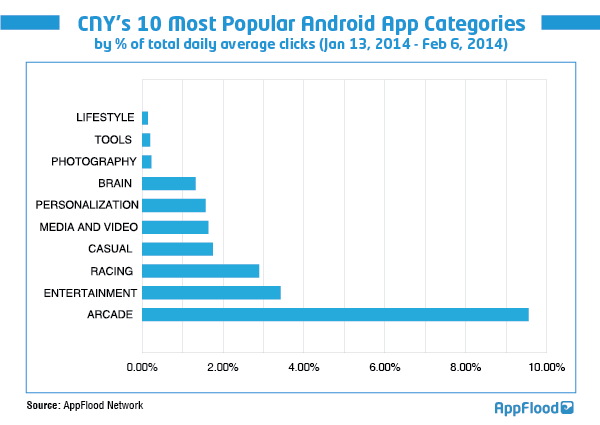
According to AppFlood, messaging service WeChat was a “de facto app during the holidays” and “clearly was the forerunner,” but other top apps by percentage of daily average clicks were arcade games and productivity-related apps. Looking at the average daily volume of clicks on mobile ads between January 12 (when app install activity spiked) and February 6 (the end of the official Chinese New Year holidays), AppFlood notes that arcade games accounted for 9.55 percent of the total daily average clicks, becoming the most popular Android app category during the period. Entertainment apps followed after with 3.42 percent.

CNY10MostPopularAndroidAppCategories 01 A new report sheds light on how the Chinese use their smartphones during Lunar New Year season

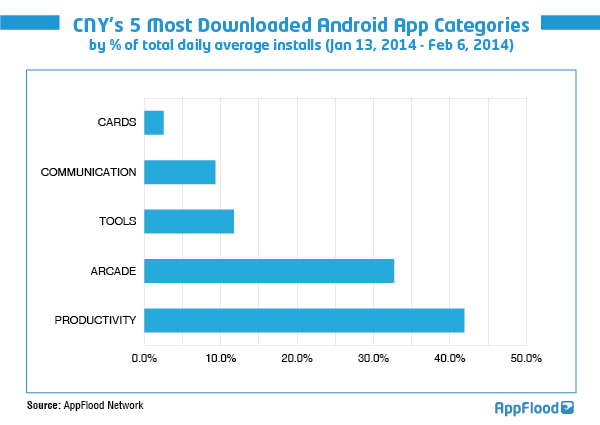
As for app installs, productivity apps topped the charts based on average daily installs during the same period, accounting for 41.9 percent of total daily installs. Arcade games followed with 32.7 percent of total installs.

CNY5MostDLAndroidAppCategories 01 A new report sheds light on how the Chinese use their smartphones during Lunar New Year season

 AppFlood notes that the “Chinese New Year holiday is one of the rare opportunities for developers to pick up quality and affordable users — particularly during the days leading up to the Chinese New Year,” due to the growth in clicks during the season.

Comparing average mobile ad installs before and after January 10 — when app installs picked up pace before the peak travel period — AppFlood finds that mobile advertisers on average chalked up 121.9 percent more installs, the bulk of them happening before January 23.

Chinese New Year is looking to be a time for tech firms to garner more eyeballs from mobile users.

Chinese search giant Baidu launched a map illustrating the most popular migration paths, while messaging app WeChat brought Chinese New Year traditions into the mobile era by tapping into digital payments and letting users send monetary gifts in place of ‘red envelopes.’

Headline image via Bikeworldtravel / Shutterstock.com

└ Tags: china, news, syndicated
a couple of laughzillas on a blue diamond background

ZTE set to unveil 6-inch Grand Memo II LTE, new Firefox OS device and updated MiFavor UI at MWC 2014

Feb18
by Sindy Cator on February 18, 2014 at 10:18 am
Posted In: Around the Web, Gadgets, Insider, smartphones

As the world’s mobile makers, app developers and service companies ready themselves to make the trip to Barcelona for Mobile World Congress 2014, Chinese handset maker ZTE couldn’t resist giving a little taste of what it’s planning to unveil.

Among the line-up for ZTE’s MWC 2014, we’ll be seeing a new 6-inch phone-cum-tablet in the form of the Grand Memo II LTE and the ‘Open C’ – a fresh addition to its Firefox OS line-up running the newest version of the software. As well as unveiling the new devices, ZTE will also be showing off its MiFavor 2.3 UI, the most recent version of its custom interface.

Naturally, we’ll be on the ground to go hands-on with the latest and greatest devices to be announced, as well as taking a peek at some of ZTE’s other gadgets like the Grand Smart Watch too.

➤ ZTE Launches Dynamic New Handsets at Mobile World Congress 2014

Featured Image Credit – STR/AFP/Getty Images


└ Tags: news, syndicated
a couple of laughzillas on a blue diamond background

No longer just a clone factory, Rocket Internet has huge plans for global e-commerce

Feb18
by Sindy Cator on February 18, 2014 at 10:10 am
Posted In: Around the Web, Asia, lazada, rocket internet, zalora

rocket 520x245 No longer just a clone factory, Rocket Internet has huge plans for global e commerce

German technology incubator Rocket Internet is most commonly associated with being a clone factory that creates imitations of successful businesses, but its ambitious strategy in emerging markets is increasingly challenging that label.

While it is true that Rocket Internet ventures take their cues from existing companies, the organization has graduated from starting and growing businesses in the hope of making ‘quick’ money from acquisitions, to a different philosophy of building longer lasting, permanent entities.

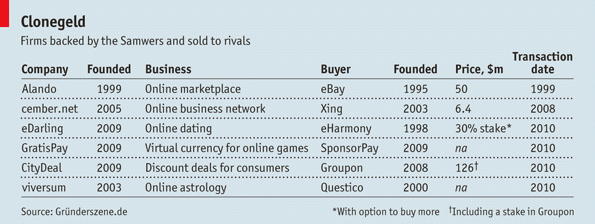
This chart from the Economist recaps the successful sales that the Samwer brothers, who own and run Rocket Internet, have overseen:

rocket internet 520x195 No longer just a clone factory, Rocket Internet has huge plans for global e commerce

Rocket Internet still pumps out a wide-variety of new companies that draw ‘inspiration’ from Silicon Valley success stories, but, as some of its early ventures mature, so the company is shifting to look at the long term for those that have made the grade. The organization remains ruthless about cutting business that aren’t performing or don’t show the requisite growth potential though — indeed, it pulled its entire operations in Turkey overnight in 2012.

Zalora IPO?

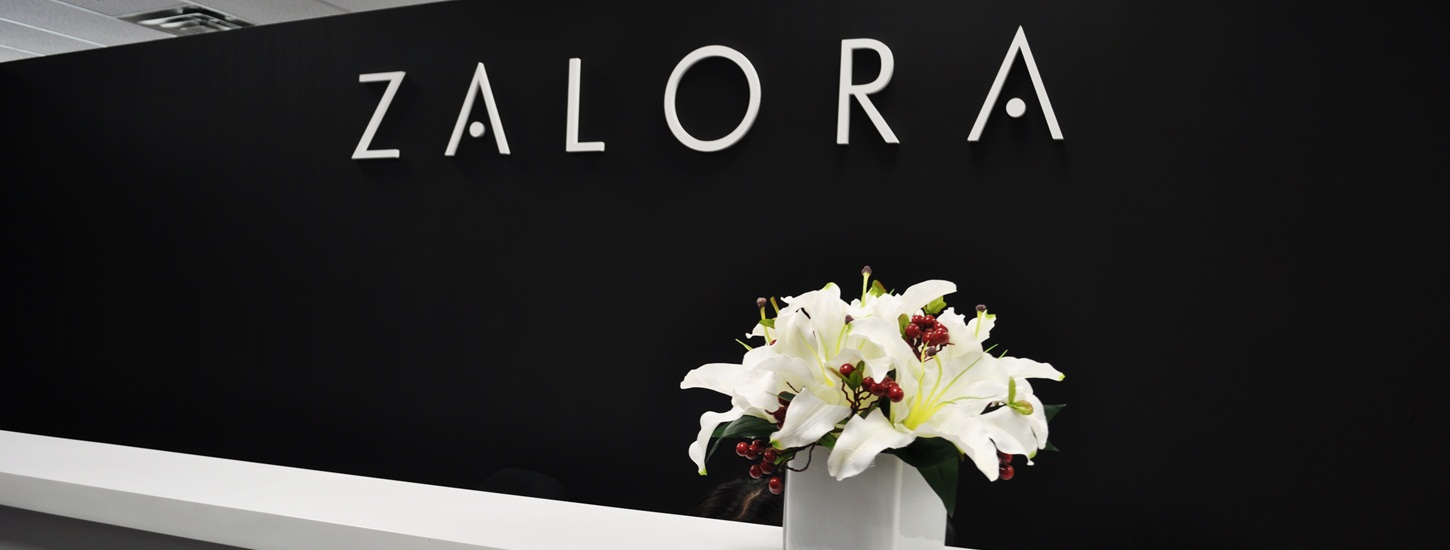
The shift in approach is most evident in Southeast Asia where a recent job ad indicates that Zalora, Rocket Internet’s online fashion retail business, is looking into a potential IPO in the US.

Zalora was launched in March 2012, and sells a range of fashion items from independent and global brands across eight markets in Southeast Asia — it covers New Zealand and Australia via a separate site, The Icon.

Alongside sister site Lazada, an Amazon-like site which began selling technology goods but has branched out into other items, Zalora is looking like the most promising venture within Rocket Internet’s portfolio. That assessment is made entirely on interest from investors, however, since neither site has disclosed financial figures.

ZALORA sign 730x276 No longer just a clone factory, Rocket Internet has huge plans for global e commerce

Money, money, money

Unlike past Rocket Internet ventures, which were built and quickly sold, Zalora and Lazada have gone past the point of being acquisition fodder for Amazon or other online retailers thinking of expanding their global footprint. That’s down to the numerous funding rounds and presumably high valuations for both businesses.

Here’s a potted history of their investment deals to date — it’s worth bearing in mind that these are funded by institutional investors, rather than regular tech-focused venture capitalists:

  • September 2012: Lazada raises “over” $50 million
  • September 2012: Zalora raises undisclosed round
  • November 2012: Lazada raises $40 million
  • December 2012: Lazada raises $26 million
  • January 2013: Lazada raises $20 million
  • March 2013: Zalora raises $26 million
  • May 2013: Zalora raises $100 million
  • June 2013: Lazada raises $100 million
  • December 2013: Zalora raises $112 million
  • December 2013: Lazada raises $250 million

That’s close to $750 million in less than two years. An incredible amount for anywhere in the world, let alone Southeast Asia, where traditional investment is comparatively scarce, to the point that corporate companies partake in startup fundraising.

It seems clear that Rocket Internet has different goals for Zalora and Lazada compared to its past initiatives. This time it is about building opportunities in green field regions where online retail is nascent and the top brands in the West are not present.

Both Zalora and Lazada anticipate profitability in 2015 so it makes sense that, having raised a lot of investment, a public listing could be a possible route to take – note: there is no evidence that Lazada is doing so, though the companies have followed similar cycles since launching.

There might yet be a bigger plan, however.

Plans to create international retail super-brands?

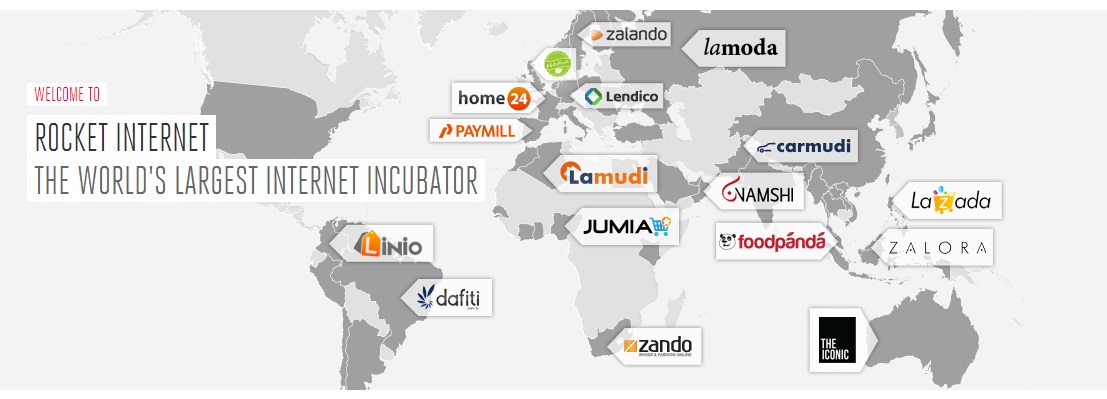
Rocket Internet and its investors haven’t just spent big in Southeast Asia. They’ve dished out major investments in e-commerce sites in Latin America, Russia, the Middle East and Africa — I was struck by the potential significance of a minor announcement last year that might just show a glimpse of what the company is planning overall for its e-commerce businesses.

Back in October 2013, Rocket Internet launched real estate platform Lamudi in an initial 12 countries across Asia, Africa and Latin America. The new site was actually a consolidation of different regional businesses, as we wrote at the time:

The launch of Lamudi sees Rocket Internet consolidate four different services — Vamido (Africa), Ubilista (Latin America), Zamudi and House (both Asia) — under one roof.

Could it be that there are plans to unite its business into huge entities? Rocket Internet is already using a ‘single brand for global business’ strategy with Uber rival EasyTaxi, FoodPanda and other businesses, so why not do the same for online retail?

Let’s recap what fashion retail businesses it has and where (there are also other Lazada-like businesses too):

  • Zalora: serves 8 (10 alongside The Icon) markets in Southeast Asia, has raised over $250 million
  • Lamoda: serves Russia and CIS, has raised over $140 million
  • Dafiti: serves 5 markets in Latin America, has raised over $220 million
  • Namshi: serves 6 markets in the Middle East, has raised over $30 million
  • Jumia: serves 6 markets in Africa, has raised over $30 million

If a united global brand is planned, then a Zalora IPO would suddenly make a great deal more sense.

Rather than floating a company with business that is operational in eight countries in Southeast Asia (a region not known for high consumer spending), it could unite the businesses in Africa, Europe, the Middle East, Latin America and Southeast Asia and float a genuinely global company.

That’s quite a number of ifs and buts and an IPO may not even occur – but the prospect of such an event shows just how far Rocket Internet has moved from its initial position as a clone factory.

We contacted Rocket Internet before publishing this article, but the company declined to comment on global plans for its e-commerce businesses. A Zalora spokesperson declined to comment on potential IPO plans when contacted by TNW.

rocketi 730x263 No longer just a clone factory, Rocket Internet has huge plans for global e commerce

Headline image via Vadim Sadovski / Shutterstock

└ Tags: europe, news, syndicated
a couple of laughzillas on a blue diamond background

No longer a clone factory, Rocket Internet has huge plans for global e-commerce

Feb18
by Sindy Cator on February 18, 2014 at 10:10 am
Posted In: Around the Web, Asia, lazada, zalora

rocket 520x245 No longer a clone factory, Rocket Internet has huge plans for global e commerce

German technology incubator Rocket Internet is most commonly associated with being a clone factory that creates imitations of successful businesses, but its ambitious strategy in emerging markets is increasingly challenging that label.

While it is true that Rocket Internet ventures take their cues from existing companies, the organization has graduated from starting and growing businesses in the hope of making ‘quick’ money from acquisitions, to a different philosophy of building longer lasting, permanent entities.

This chart from the Economist recaps the successful sales that the Samwer brothers, who own and run Rocket Internet, have overseen:

rocket internet 520x195 No longer a clone factory, Rocket Internet has huge plans for global e commerce

Zalora IPO?

Things are changing however. The shift in approach is most evident in Southeast Asia where a recent job ad indicates that Zalora, Rocket Internet’s online fashion retail business, is looking into a potential IPO in the US.

Zalora was launched in March 2012, and sells a range of fashion items from independent and global brands across eight markets in Southeast Asia — it covers New Zealand and Australia via a separate site, The Icon.

Alongside sister site Lazada, an Amazon-like site which began selling technology goods but has branched out into other items, Zalora is looking like the most promising venture within Rocket Internet’s portfolio. That assessment is made entirely on interest from investors, however, since neither site has disclosed financial figures.

ZALORA sign 730x276 No longer a clone factory, Rocket Internet has huge plans for global e commerce

Money, money, money

Unlike past Rocket Internet ventures, which were built and quickly sold, Zalora and Lazada have gone past the point of being acquisition fodder for Amazon or other online retailers thinking of expanding their global footprint. That’s down to the numerous funding rounds and presumably high valuations for both businesses.

Here’s a potted history of their investment deals to date — it’s worth bearing in mind that these are funded by institutional investors, rather than regular tech-focused venture capitalists:

  • September 2012: Lazada raises “over” $50 million
  • September 2012: Zalora raises undisclosed round
  • November 2012: Lazada raises $40 million
  • December 2012: Lazada raises 26 million
  • January 2013: Lazada raises $20 million
  • March 2013: Zalora raises $26 million
  • May 2013: Zalora raises $100 million
  • June 2013: Lazada raises $100 million
  • December 2013: Zalora raises $112 million
  • December 2013: Lazada raises $250 million

That’s close to $750 million in less than two years. An incredible amount for anywhere in the world, let alone Southeast Asia, where traditional investment is comparatively scarce, to the point that corporate companies partake in startup fundraising.

It seems clear that Rocket Internet has different goals for Zalora and Lazada compared to its past initiatives. This time it is about building opportunities in green field regions where online retail is nascent and the top brands in the West are not present.

Both Zalora and Lazada anticipate profitability in 2015 so it makes sense that, having raised a lot of investment, a public listing could be a possible route to take – note: there is no evidence that Lazada is doing so, though the companies have followed similar cycles since launching.

There might yet be a bigger plan, however.

Plans to create international retail super-brands?

Rocket Internet and its investors haven’t just spent big in Southeast Asia. They’ve dished out major investments in e-commerce sites in Latin America, Russia, the Middle East and Africa — I was struck by the potential significance of a minor announcement last year that might just show a glimpse of what the company is planning overall for its e-commerce businesses.

Back in October 2013, Rocket Internet launched real estate platform Lamudi in an initial 12 countries across Asia, Africa and Latin America. The new site was actually a consolidation of different regional businesses, as we wrote at the time:

The launch of Lamudi sees Rocket Internet consolidate four different services — Vamido (Africa), Ubilista (Latin America), Zamudi and House (both Asia) — under one roof.

Could it be that there are plans to unite its business into huge entities? Rocket Internet is already using a ‘single brand for global business’ strategy with Uber rival EasyTaxi, FoodPanda and other businesses, so why not do the same for online retail?

Let’s recap what fashion retail businesses it has and where (there are also other Lazada-like businesses too):

  • Zalora: serves 8 (10 alongside The Icon) markets in Southeast Asia, has raised over $250 million
  • Lamoda: serves Russia and CIS, has raised over $140 million
  • Dafiti: serves 5 markets in Latin America, has raised over $220 million
  • Namshi: serves 6 markets in the Middle East, has raised over $30 million
  • Jumia: serves 6 markets in Africa, has raised over $30 million

If a united global brand is planned, then a Zalora IPO would suddenly make a great deal more sense.

Rather than floating a company with business that is operational in eight countries in Southeast Asia (a region not known for high consumer spending), it could unite the businesses in Africa, Europe, the Middle East, Latin America and Southeast Asia and float a genuinely global company.

That’s quite a number of ifs and buts and an IPO may not even occur – but the prospect of such an event shows just how far Rocket Internet has moved from its initial position as a clone factory.

We contacted Rocket Internet before publishing this article, but the company declined to comment on global plans for its e-commerce businesses. A Zalora spokesperson declined to comment on potential IPO plans when contacted by TNW.

rocketi 730x263 No longer a clone factory, Rocket Internet has huge plans for global e commerce

Headline image via Vadim Sadovski / Shutterstock

└ Tags: europe, news, syndicated
  • Page 14,501 of 14,637
  • « First
  • «
  • 14,499
  • 14,500
  • 14,501
  • 14,502
  • 14,503
  • »
  • Last »
The Daily Dose, The Daily Dose © 1996 - Present. All Rights Reserved.
  • Home
  • About
  • Archive
  • Books
  • Collections
  • Links
  • Shop
  • Submit a joke
  • Video
  • Privacy Policy