

Dilbert readers – Please visit Dilbert.com to read this feature. Due to changes with our feeds, we are now making this RSS feed a link to Dilbert.com.
 Laughzilla the Third (2012)
The Third Volume in the Funny Stuff Cartoon Book Collection Available Now. |
 Themes Memes and Laser Beams - The Second Volume in the Funny Stuff Cartoon Book Collection. Click Here to get the book in Paperback While Available on Amazon |

Funny Stuff : The First Cartoon Book from The Daily Dose. Available on Lulu. |
Dilbert readers – Please visit Dilbert.com to read this feature. Due to changes with our feeds, we are now making this RSS feed a link to Dilbert.com.

A team of Brazilian astronomers recently determined a giant exoplanet, over thirteen times more massive than Jupiter, is likely responsible for some funky orbital observations of a far away half-dead binary system. How it got there remains a mystery, but the scientists have some interesting theories. KIC 10544976 – or ‘the place where a big ass planet got discovered’ as we like to call it – is a binary system (comprised of two stars) considered to be ‘evolved.’ Another way of putting it is that they’re old. They’re so old, in fact, that one of them is actually a white…
This story continues at The Next Web

Someone’s apparently planning to recreate a battle royale match in reality, if an advertisement on a swank website is any indication. The unnamed millionaire is offering to pay a princely sum for help making this endeavor work, but I’ll tell them this, right now, for free: it isn’t going to. The advertisement is on HushHush, an online marketplace that bills itself as being for the rich and luxury-loving of the world — expensive jewelry, rare cars, pretty much what you’d expect. The site also has a “requests” category, and in this case the request is for someone to help a…
This story continues at The Next Web
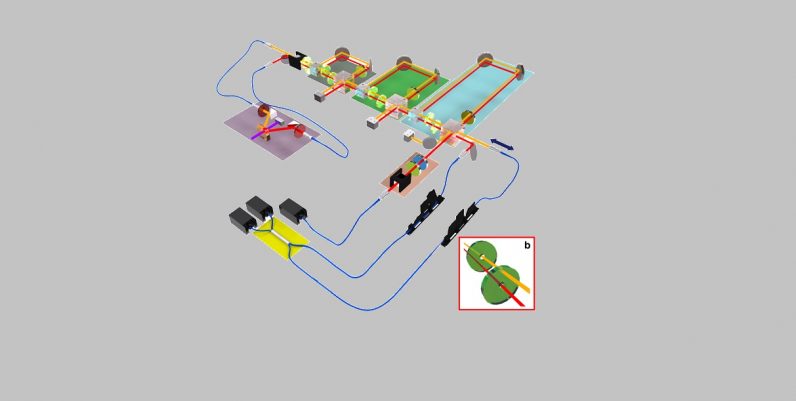
A team of scientists from Griffith University in Australia and Nanyang Technological University (NTU) Singapore have developed a quantum-powered machine that accurately simulates future outcomes. This research has huge implications at the intersection of quantum mechanics and machine learning. The team created a photonic quantum information processor that determines the possible trajectories of single photons of light at the same time, using quantum superposition, then ranks them by order of probability. If this sounds complex, it’s because it is: this is a unique experiment and, to the best of our knowledge, the only of its kind to prove successful. Humans…
This story continues at The Next Web

The majority of ‘gaming phones’ from 2018 -including the Razer Phone 2, Asus’ ROG Phone, and Xiaomi’s Black Shark – were all powered by Qualcomm’s flagship Snapdragon 845 chip. It’s the same processor that was under the hood of many high-end non-gaming models from other brands, which means you weren’t getting anything special in terms of processing power. Now, the chip maker has unveiled the Snapdragon 730G, its first gaming-focused processor targeting mid-range phones. The Snapdragon 730G – launched alongside the Snapdragon 730 and the Snapdragon 655 – packs a bunch of gaming-related features like a Wi-Fi latency manager, and…
This story continues at The Next Web