The Daily Dose

laugh every day with cartoons jokes and humor
  • Home
  • About
    • Press
      • Press Release – Announcing Laughzilla the Third ebook
      • Press Release – The Daily Dose Kicks Off Its 16th Year with New Books and More Irreverent Laughter
      • Press Release – Themes Memes and Laser Beams Now Available in Paperback
      • Press Release – Announcing Themes Memes and Laser Beams
      • In The News
    • Privacy
  • Archive
  • Books
  • Shop
  • Collections
    • Galleries
      • Gallery
      • Captions
      • Flash Cartoons & Greeting Cards
        • Laughzilla’s Oska Flash Animation Cartoon Greeting Cards
        • Oska Cupid Love Humor
    • #OccupyWallStreet
    • cats
    • China
    • Food
      • Hors d’oeuvres
        • Ball of Cream Cheese
      • Entrees / Main Courses
        • Meatballs with Baked Beans and Celery
    • Gadaffy
    • Google
  • Links
  • Video
  • Submit a joke
DeviantART Facebook Twitter Flickr pinterest YouTube RSS

Subscribe for Free Laughs!


Latest Comics

  • This Memorial Day, Trump Meme Coin Congratulates Profit Takers
  • 25 Years of The Daily Dose
  • The Best Cartoons
  • Bitcoin sings “Fly Me To The Moon”
  • 22 years of The Daily Dose

Comic Archive

Gadaffy Assad Annan Caricature

Daily Dose News Roundup

  • Anthropic cuts Claude subscribers off from OpenClaw in cost crackdown
  • Musk wants a million data centre satellites. Bezos wants 51,600. Scientists want to know why.
  • Google launches Gemma 4: four open-weight models from smartphones to workstations
  • WhatsApp just caught an Italian spyware firm building a fake version of its app for iPhones
  • Decentraland just launched on the Epic Games Store.

Quotable

"Ironically, the big Social Networks do not like to network with other social networks. Maybe they should be called Anti-Social Networks." ~ Yasha Harari

Fresh Baked Goods

Get The Daily Dose's ebook: Laughzilla the Third - A Funny Stuff Collection of 101 Cartoons from TheDailyDose. Click here to get the e-book on Amazon kdp. Laughzilla the Third (2012) The Third Volume in the Funny Stuff Cartoon Book Collection Available Now.

Click here for the Paperback edition


Support independent publishing: Buy The Daily Dose's book: Themes Memes and Laser Beams - A Funny Stuff Collection of 101 Cartoons by Laughzilla from TheDailyDose. Click here to get the book on Amazon. Themes Memes and Laser Beams - The Second Volume in the Funny Stuff Cartoon Book Collection.

Click Here to get the book in Paperback While Available on Amazon

Themes Memes and Laser Beams - 101 Cartoons by Laughzilla. Get the e-book on Lulu.

Click Here to get The Daily Dose Cartoon ebook on amazon kindle

Funny Stuff :
The First Cartoon Book
from The Daily Dose.
Available on Lulu.

a couple of laughzillas on a blue diamond background

It’s a done deal: Google has completed its $3.2 billion acquisition of Nest

Feb12
by Sindy Cator on February 12, 2014 at 12:35 pm
Posted In: Around the Web, Google, Insider

Google completed its acquisition of Nest on February 7, it was revealed today in a regulatory filing with the US Securities and Exchange Commission.

The $3.2 billion deal was one of Google’s most high-profile and unexpected buyouts in recent memory, obtaining the hardware company’s portfolio of home automation devices and staff, led by former iPod designer Tony Fadell.

Last month, the ex-Apple visionary described some of the meetings he had with Larry Page and other Google executives prior to the deal’s completion:

“The two-way interchange of what was, for me, intellectual happiness and the stimulation of being able to go back and forth and really create a new world together – and in a different way than either of us had imagined – that was personally exciting to me.”

Reports have suggested that Google will now use Nest to lead its core hardware group moving forward.

Read Next: Nest CEO Tony Fadell vows to make any privacy policy changes transparent and opt-in / The ‘father of the iPod’ explains how his company Nest is using tech to make your home ‘conscious’

➤ 10-K filing (Via Recode)

Image Credit: George Frey/Getty Images

└ Tags: news, syndicated
a couple of laughzillas on a blue diamond background

After NSA revelations, the EU wants Internet governance to be less concentrated in the US

Feb12
by Sindy Cator on February 12, 2014 at 11:57 am
Posted In: Around the Web

kroes crop 786x305 520x245 After NSA revelations, the EU wants Internet governance to be less concentrated in the US

The European Commission put forward fresh measures today to share the management and operations of Internet infrastructure among the international community, making it more open, accountable and secure.

Among its proposals, the Commission is asking for the responsibilities bestowed upon the Internet Corporation for Assigned Names and Numbers (ICANN), a nonprofit based in the United States, to be distributed globally. It would include the duties of the Internet Assigned Numbers Authority (IANA), a department of ICANN which allocates IP addresses and manages root nameservers for the DNS.

The Commission also wants to bolster the Internet Governance Forum, a body for governments and industry stakeholders to discuss and debate policy, and review any outstanding conflicts in national law related to the accountability and management of current Internet infrastructure.

Neelie Kroes, Vice-President for the European Commission, said these actions were “critical” for “redrawing” how the Internet is managed and governed on a global scale. “Europe must contribute to a credible way forward for global internet governance,” she said. “Europe must play a strong role in defining what the net of the future looks like.”

The Commission says its in support of a “real multi-stakeholder governance model” that would involve multiple parties, including individuals and organizations, taking on these responsibilities.

In a press release, the commission referenced the US government’s widespread surveillance techniques, unearthed last year by NSA whistleblower Edward Snowden. While the relationship between these revelations and ICANN’s powers were not addressed, Kroes suggested that governments shouldn’t control the new model.

“I agree that governments have a crucial role to play, but top-down approaches are not the right answer,” she said. “We must strengthen the multi-stakeholder model to preserve the Internet as a fast engine for innovation.”

Specifically, she mentioned the International Telecommunications Union – a UN agency that was criticised by the European Parliament in November 2012 when it was suggested it should take on powers currently held by US bodies.

Read Next: Obama reforms US surveillance work, seeks alternative to domestic phone metadata program by April

➤ Press Release (Via The Verge)

Image Credit: Martijn Beekman/AFP/Getty Images

└ Tags: europe, news, syndicated
a couple of laughzillas on a blue diamond background

As LinkedIn passes 50 million users in Asia, it knows there’s still a lot of room to grow

Feb12
by Sindy Cator on February 12, 2014 at 11:23 am
Posted In: Around the Web, Asia

linkedin 520x245 As LinkedIn passes 50 million users in Asia, it knows theres still a lot of room to grow

LinkedIn has been growing rapidly in Asia-Pacific, as it announced today that it just crossed 50 million registered users in the region — that’s nearly triple the number in less than three years. The company opened its regional center in Singapore in May 2011.

Last year, more than seven million new members joined the network in India alone, while across the Southeast Asia region its userbase jumped more than 50 percent to reach over nine million.

Today, nine countries in Asia-Pacific have more than a million LinkedIn members each — India has 24 million users, Australia has five million, China has about four million, Indonesia and the Philippines have over two million each, while Japan, Singapore, Malaysia and New Zealand each number more than one million.

Hari Krishnan, LinkedIn’s managing director of Asia-Pacific and Japan, tells TNW in an interview that it’s because of its “members-first” approach that its partners in the ecosystem — including users, recruiters and companies — can get value out of its service.

When you look at our members, they look at achieving three objectives on LinkedIn. LinkedIn is their professional profile on record. The second thing is that they look to maintain and develop a professional network, (and) the third is that they try to gain professional knowledge… If you think about these three ways that people are using LinkedIn, that’s why we’ve had more and more people sign up.

Educational content for young Asian professionals

116652133 730x417 As LinkedIn passes 50 million users in Asia, it knows theres still a lot of room to grow

Krishnan notes that LinkedIn has, in particular, placed a lot of emphasis on the third element as it seeks to help professionals consume relevant content. To date, the career-focused social network has 1.5 million publishers who get their content posted up, as well as over 450 LinkedIn Influencers. Given that there is a high percentage of young people in the workforce in Asia’s emerging markets, this means professionals are trying to learn and “that’s a good opportunity for them to use LinkedIn,” Krishnan says.

In particular, as Asia increasingly becomes a key part of the global economy, this has allowed young professionals in the region to understand what is going on in the rest of the world.

The fastest-growing demographic on LinkedIn is students, Krishnan notes — there are over 30 million students on the network now, out of a global userbase of 277 million, and thousands of universities have created pages on the platform. He says that students are an important avenue of growth for LinkedIn.

This is also key for Asia, given that LinkedIn’s immediate focus is on knowledge workers — professionals and students who are entering the workforce — and Krishnan says 40 percent of this audience resides in Asia.

“Even though we have 50 million members, there’s a long runway ahead in terms of how we can grow… If you look at Southeast Asia and North Asia, there’s a lot of space to grow. And even though we have 24 million members in India, there are lots more [potential members],” Krishnan acknowledges.

The launch of University Pages on LinkedIn last year has also contributed to LinkedIn’s membership growth in Asia and will continue playing a key role in the company’s regional expansion, Krishnan notes.

“Universities are such an important stakeholder in the global economy,” Krishnan says, and LinkedIn can in turn give them more information about what companies are looking for in their future employees.

LinkedIn zooms in on mobile

Mobile is another area in which LinkedIn has focused on, which has in turn benefited its Asia expansion — considering that the region is undergoing a mobile revolution. Roughly half of the world’s mobile connections are now in Asia Pacific, with some 1.6 billion unique subscribers, according to a report last year from the GSM Association.

90498861 730x523 As LinkedIn passes 50 million users in Asia, it knows theres still a lot of room to grow

“In Asia, mobile leads the way – and if you look at 2013, we have expanded our mobile offerings significantly,” Krishnan says. In total, LinkedIn has three apps for consumers — the core app for mobile devices, LinkedIn Contacts, as well as a professional news app LinkedIn Pulse.

As of the fourth quarter last year, mobile represents 41 percent of all traffic to LinkedIn. In the meantime, as of October 2013, more than 10 people searches are done every second from mobile devices, while over 124 LinkedIn profiles are viewed every second on handsets, and more than 30 percent of LinkedIn job views come from mobile.

As LinkedIn is trying to understand what tools professionals are using in each market, some of the company’s moves have also been tailored to its Asia audience. For example, LinkedIn built an application for the Nokia Asha platform, which is targeted at India and Indonesia.

Early days for LinkedIn China

Regarding competition, Krishnan acknowledges that there are competing services (such as those listed here), but LinkedIn isn’t focused on them — instead it’s concentrating its efforts on customers and improving the site so their users have no reason to head elsewhere.

This leads us to China, the country where LinkedIn already has over four million members despite not having a localized language site.

“We want you to think of us whenever you need some sort of assistance,” Krishnan says — for example by looking up a LinkedIn profile of a prospective employee, looking up a company before you head to an interview, or looking up news that a particular company has shared before you embark on a sales pitch.

LinkedIn made a move in the country last month with the appointment of Derek Shen, the founder and former CEO of Chinese Groupon-like group-buying site Nuomi, as the president of LinkedIn China. A recent WeChat update also revealed that the wildly-popular messaging service has integrated profiles from the network.

156305046 730x486 As LinkedIn passes 50 million users in Asia, it knows theres still a lot of room to grow

Krishnan emphasizes that it’s still early days in China — though the country is “absolutely important” to LinkedIn. Developing further in China therefore seems to be a key chapter for LinkedIn this year, and could propel its growth further.

Challenges in Asia

With LinkedIn’s focus on mobile and appealing to young professionals — who make up a huge part of the workforce in Asia — it is little wonder that it is posting steady growth in the region.

The challenge that comes next for LinkedIn would likely be keeping its users engaged enough to turn to the social network frequently, and tapping on stakeholders such as companies, universities, marketers and recruiters to make more use of it. In essence, LinkedIn needs to provide enough value for its users — which means it has to relentlessly improve on its features. And it will be interesting to see how the Asian market responds to LinkedIn’s efforts, as it strives to ingrain itself further into this burgeoning circle of students and young professionals across the region.

Headline image via Ben Scholzen / Flickr, other images via Getty Images, Getty Images and Getty Images

└ Tags: news, syndicated
a couple of laughzillas on a blue diamond background

How ‘social fingerprinting’ company Trustev uses Facebook to decide if you can have that new phone

Feb12
by Sindy Cator on February 12, 2014 at 9:48 am
Posted In: Around the Web, Insider

154597247 520x245 How social fingerprinting company Trustev uses Facebook to decide if you can have that new phone

The first time we caught up with Trustev was almost exactly one year ago; it had just secured £300,000 in funding to bring its ‘social fingerprinting’ to market.

In May last year, the platform went live for Trustev customers and then subsequently secured another $3 million in backing – announced at the Dublin Web Summit in October last year.

In essence, what the company does is integrate its social fingerprinting tech into other businesses’ systems. So, that could be a high-end clothes retailer, phone shop, loan application system, or any other situation where verifying the identity of the customer is of paramount importance.

To carry out this verification, it uses social data from services like Facebook, LinkedIn and Twitter to check that people are who they say they are. Site owners can then implement the company’s core identity checking service with just two lines of code.

At Finovate Europe today, the company is showing off the newest string to its bow, its Trusted Retail Decisions module. The system is destined to be used by at least two UK mobile phone retailers in the near future, with trials due to start next week. Alas, the company wasn’t allowed to name them for security reasons, but both have big national retail operations.

What’s the problem with existing systems?

According to the company, millions of pounds of mobile phone fraud is carried out each year. A customer walks into a shop, starts a new contract using bogus identity information and walks out with a new phone. It’s not until, at the very least, a few days later that the network realises that the information isn’t genuine, by which time the fraudster and phone are long gone.

The handsets tend to be sent abroad, and the SIMs remain in this country, sold on and used by others. On average, the spend in this first month on fraudulent SIMs is usually around £1,000, Trustev said. It’s only usually at this point that the company realises something is amiss and puts a block on further spending.

trustev1 730x636 How social fingerprinting company Trustev uses Facebook to decide if you can have that new phone

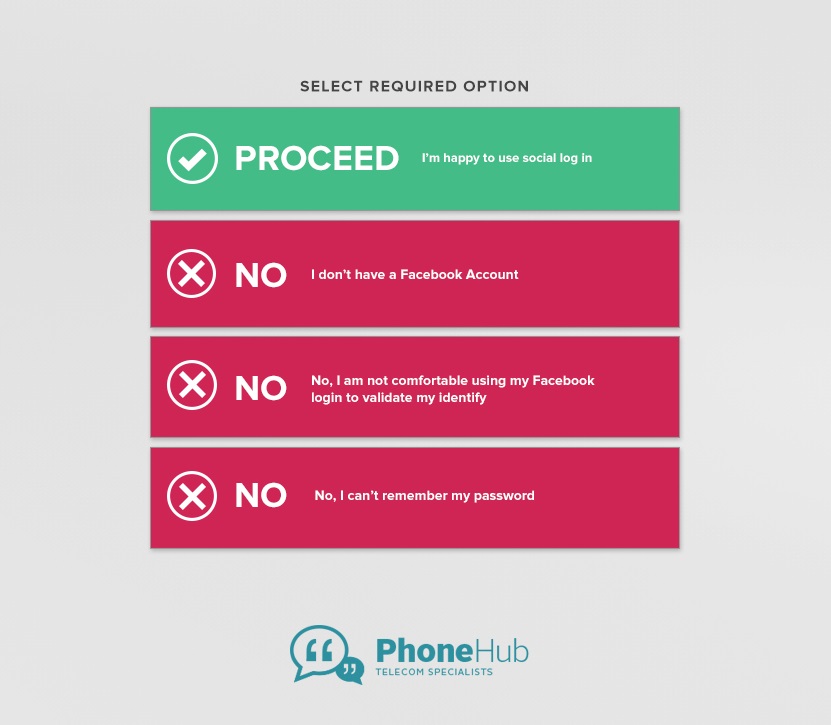
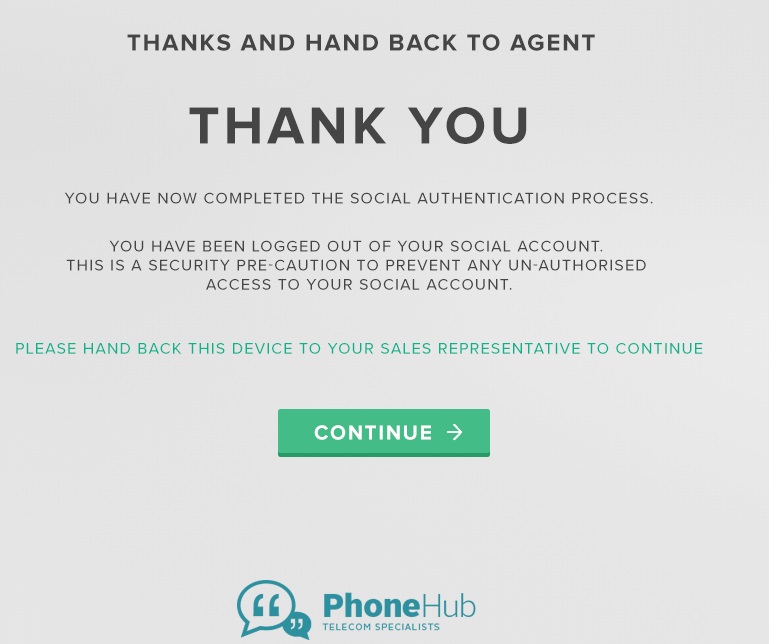
With the Trustev Retail Decision system this shouldn’t be possible. All the normal forms of identification are used by the store, but the customer is then passed a tablet and asked to log into one of their social accounts, like Facebook, Twitter, LinkedIn, etc. CMO of Trustev Donal Cahalane told TNW that virtually any other social service with an open API could be integrated and used to draw information.

The application then scans the social profile data to verify that the customer is indeed who they say they are and that it matches with known information, it then determines an overall confidence score, logs you out of your profile (no data is stored whatsoever – it’s simply used to generate a score) and returns you to the retailer-branded app.

Trustev3 730x611 How social fingerprinting company Trustev uses Facebook to decide if you can have that new phone

One of the advantages of the Trustev system for its own customers is that it provides a far cheaper way for smaller startups focused on crowd-funding or P2P lending to carry out identity checks than current systems, Cahalane explained:

The legacy [systems] were designed for banking. For when you and me were going to apply for our mortgage, so they can charge £10-£15 for an identity check, but if you’re building an online business in the new financial space, you can’t pay £15 every time you want to verify an identity.

We have what we call ‘a 75 percent’ check – that bit at the start where we weed out most of the nonsense, so on the front end you get rid of all those [unecessary checks] then down the road, if you want to, you can pay for one of the heavier level checks

While the in-store system is the newest part of Trustev’s business, it’s not the main part – that’s largely providing authentication services for online retailers and other businesses. For this it uses a system of continual checks across a website as the customer is using it, but it’s designed to be as unobtrusive as possible.

At the moment, everybody works on the principle of ‘you’re a bad guy, you have to prove to us that we should trust you with our product and services’, so you have to give them all your information. We want to reverse that, we want to assume that you’re a good guy until we find something wrong.

Cahalane went on to explain that the system has smarts too. For example, it might recognize that you’re visiting a site using a masked IP address or through a proxy, but it also has the ability to understand that you might only be doing that because you want to access US Netflix content, rather than for more nefarious purposes.

That alone is not an indication of being a criminal mastermind… Our algorithms re-weight themselves based on the amount of data they get. If they’re getting piles and piles of data, they’ll re-weight themselves in real-time to give the most accurate number [confidence score] that they can.

We want to show people that their digital identities can be used to make their life a bit easier.

You might never see or know it, but if you buy luxury goods or big-ticket tech items online, or live in the UK and are going to be upgrading your phone in the near future, you could be using Trustev’s social fingerprinting to make sure you are who you say you are.

Featured Image Credit – Getty Images

└ Tags: news, syndicated
a couple of laughzillas on a blue diamond background

Oppo is launching its Find 7 smartphone on March 19 in Beijing

Feb12
by Sindy Cator on February 12, 2014 at 8:28 am
Posted In: Around the Web, Asia, Gadgets, Product Launches, Smartphone

Chinese smartphone manufacturer Oppo announced today that it will be launching its Find 7 smartphone on March 19 in Beijing, China.

Oppo Find7 Oppo is launching its Find 7 smartphone on March 19 in Beijing

Oppo was founded in 2004 as an electronics manufacturer, but last year it started rolling out smartphones with top-of-the-line specs worth boasting about. We noted that the Find 5 was one of the most well-built phones we’ve seen come out of China. In September 2013, Oppo took the wraps off N1, its latest flagship smartphone with a camera constructed from 67 different components, which it claims is the first to feature a six-piece lens design in an Android smartphone.

It will be interesting to see what Oppo can deliver with Find 7. Rumored specifications point to a 5.5-inch Quad HD display, with the device running on a Snapdragon 800 or 805 processor with 3GB of RAM, as well as a 13-megapixel camera.

➤ They are coming. #AlwaysImprove #Find7 [Oppo Google+]

└ Tags: china, news, syndicated
  • Page 14,545 of 14,636
  • « First
  • «
  • 14,543
  • 14,544
  • 14,545
  • 14,546
  • 14,547
  • »
  • Last »
The Daily Dose, The Daily Dose © 1996 - Present. All Rights Reserved.
  • Home
  • About
  • Archive
  • Books
  • Collections
  • Links
  • Shop
  • Submit a joke
  • Video
  • Privacy Policy