The Daily Dose

laugh every day with cartoons jokes and humor
  • Home
  • About
    • Press
      • Press Release – Announcing Laughzilla the Third ebook
      • Press Release – The Daily Dose Kicks Off Its 16th Year with New Books and More Irreverent Laughter
      • Press Release – Themes Memes and Laser Beams Now Available in Paperback
      • Press Release – Announcing Themes Memes and Laser Beams
      • In The News
    • Privacy
  • Archive
  • Books
  • Shop
  • Collections
    • Galleries
      • Gallery
      • Captions
      • Flash Cartoons & Greeting Cards
        • Laughzilla’s Oska Flash Animation Cartoon Greeting Cards
        • Oska Cupid Love Humor
    • #OccupyWallStreet
    • cats
    • China
    • Food
      • Hors d’oeuvres
        • Ball of Cream Cheese
      • Entrees / Main Courses
        • Meatballs with Baked Beans and Celery
    • Gadaffy
    • Google
  • Links
  • Video
  • Submit a joke
DeviantART Facebook Twitter Flickr pinterest YouTube RSS

Subscribe for Free Laughs!


Latest Comics

  • This Memorial Day, Trump Meme Coin Congratulates Profit Takers
  • 25 Years of The Daily Dose
  • The Best Cartoons
  • Bitcoin sings “Fly Me To The Moon”
  • 22 years of The Daily Dose

Comic Archive

Hebrews Or Syrians Fleeing Occupy Exodus

Daily Dose News Roundup

  • Alibaba sells its Lingxi games arm to fund an all-in bet on AI
  • Altman says four years of college may be more than the world now needs
  • EV prices rose for the first time in 2026, and the discounts are why
  • Pony.ai and Uber to put more than 2,000 Chinese robotaxis on European streets
  • The next great game may not come from a million-dollar studio

Quotable

"90% of the people in the stock market, professionals and amateurs alike, simply haven't done enough homework." ~ Investor's Proverb

Fresh Baked Goods

Get The Daily Dose's ebook: Laughzilla the Third - A Funny Stuff Collection of 101 Cartoons from TheDailyDose. Click here to get the e-book on Amazon kdp. Laughzilla the Third (2012) The Third Volume in the Funny Stuff Cartoon Book Collection Available Now.

Click here for the Paperback edition


Support independent publishing: Buy The Daily Dose's book: Themes Memes and Laser Beams - A Funny Stuff Collection of 101 Cartoons by Laughzilla from TheDailyDose. Click here to get the book on Amazon. Themes Memes and Laser Beams - The Second Volume in the Funny Stuff Cartoon Book Collection.

Click Here to get the book in Paperback While Available on Amazon

Themes Memes and Laser Beams - 101 Cartoons by Laughzilla. Get the e-book on Lulu.

Click Here to get The Daily Dose Cartoon ebook on amazon kindle

Funny Stuff :
The First Cartoon Book
from The Daily Dose.
Available on Lulu.

a couple of laughzillas on a blue diamond background

Alibaba goes all out to boost its entertainment offerings by taking a stake in ChinaVision Media

Mar12
by Sindy Cator on March 12, 2014 at 3:49 am
Posted In: Around the Web, Asia, Entertainment

146576764 520x245 Alibaba goes all out to boost its entertainment offerings by taking a stake in ChinaVision Media

It is clear that Chinese e-commerce giant Alibaba wants to branch out further into digital entertainment — last year it acquired social music-streaming service Xiami and developed a smart TV operating system, while this year it stepped into mobile games.

Now Alibaba has agreed to pay $804 million for a majority stake in ChinaVision Media Group, a Hong Kong firm specializing in TV and film production. This could very possibly mean that Alibaba may soon be taking steps to produce content in collaboration with ChinaVision. After all, throughout last year, Chinese tech firms were already taking steps to make their mark within the online video space, seeking to capitalize on the opportunities as Chinese consumers effectively started taking their TVs to the subway.

An Alibaba spokesperson tell us: We are pleased to collaborate with the ChinaVision Media Group to explore future business opportunities as part of Alibaba’s digital entertainment strategy.”

The company’s strategy has been pretty clear — by beefing up its services to include TVs, music and games, it is hoping to provide a diverse range of offerings to capture the attention of users and keep them within its ecosystem, which could ultimately lead to more e-commerce opportunities.

In April, Alibaba’s Taobao Marketplace rolled out functionality for Xiami, apparently to help transform the retail site from merely a shopping platform to a lifestyle and media platform. Subsequently, the company also rolled out smart TVs, which would incorporate e-commerce and support games and other forms of entertainment. Early this year, it launched mobile games on its Taobao shopping app and Laiwang chat app.

Headline image via Peter Parker/AFP/Getty Images

└ Tags: china, news, syndicated
a couple of laughzillas on a blue diamond background

In China, tech firms are issuing virtual credit cards to make online shopping easier

Mar12
by Sindy Cator on March 12, 2014 at 3:03 am
Posted In: Around the Web, Asia, e-commerce

shutterstock 148437164 520x245 In China, tech firms are issuing virtual credit cards to make online shopping easier

In China, tech firms are making it easier for consumers than ever before to shop and purchase goods online.

Rather than requiring you to have a traditional credit card applied via banks, Chinese e-commerce giant Alibaba announced that its payments arm Alipay will collaborate with China’s CITIC Bank to start issuing one million virtual credit cards next week, approving the creditworthiness of applicants based on their online shopping histories.

This means that CITIC Bank will impose credit limits based on information from Alipay on the applicant’s online shopping behavior. The minimum credit limit is CNY200 ($33).

Consumers can use the virtual credit card only on e-commerce platforms that accept CITIC credit cards, Alipay says. It can, however, also be used at offline retail outlets that accept Alipay’s Wallet app as a payment method.

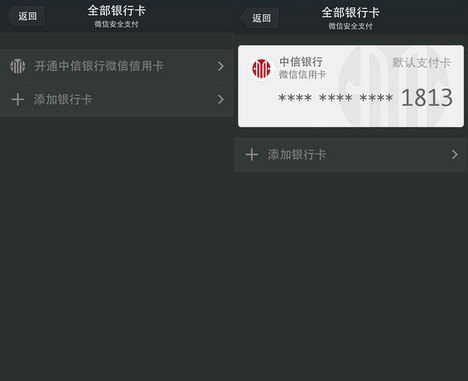
In the meantime, Chinese Internet giant Tencent, which owns popular messaging service WeChat, is teaming up with CITIC Bank and Zhong An Online Property Insurance to issue one million virtual credit cards too.

In a statement sent to TNW, Tencent says that users of WeChat (known as Weixin in China) can apply for the card with a minimum credit limit of CNY50 ($8) and a maximum of CNY5,000 ($814). Consumers can use the card when paying via Weixin, or at designated offline retail outlets that support the scanning of Weixin QR codes.

Weixin Credit In China, tech firms are issuing virtual credit cards to make online shopping easier

A Tencent spokesperson says: “Introducing this virtual credit card is mainly to help users who have good credit records but are lacking short-term funds to quickly meet their consumption needs. For the businesses, this can maximize sales.”

Both Alibaba and Tencent say that the approval process for their virtual credit cards will take less time than conventional credit applications.

Last month, online retailer JD.com — which Tencent recently announced it was taking a 15 percent stake in — also launched a virtual credit card. However, that wasn’t in collaboration with any banks and was for use only on its e-commerce platform.

Alibaba and Tencent’s foray into providing credit for customers comes as both Internet firms have been selected to take part in the preparation work for setting up five new private banks in China. It seems like Alibaba and Tencent are well on their way to forming complete ecosystems in the Internet world which extend not only to purchasing products but to payment, credit and financial products as well.

Headline image via Shutterstock

└ Tags: news, syndicated
a couple of laughzillas on a blue diamond background

In China, tech firms are issuing virtual credit cards to make online shopping easier

Mar12
by Sindy Cator on March 12, 2014 at 3:03 am
Posted In: Around the Web, Asia, e-commerce

shutterstock 148437164 520x245 In China, tech firms are issuing virtual credit cards to make online shopping easier

In China, tech firms are making it easier for consumers than ever before to shop and purchase goods online.

Rather than requiring you to have a traditional credit card applied via banks, Chinese e-commerce giant Alibaba announced that its payments arm Alipay will collaborate with China’s CITIC Bank to start issuing one million virtual credit cards next week, approving the creditworthiness of applicants based on their online shopping histories.

This means that CITIC Bank will impose credit limits based on information from Alipay on the applicant’s online shopping behavior. The minimum credit limit is CNY200 ($33).

Consumers can use the virtual credit card only on e-commerce platforms that accept CITIC credit cards, Alipay says. It can, however, also be used at offline retail outlets that accept Alipay’s Wallet app as a payment method.

In the meantime, Chinese Internet giant Tencent, which owns popular messaging service WeChat, is teaming up with CITIC Bank and Zhong An Online Property Insurance to issue one million virtual credit cards too.

In a statement sent to TNW, Tencent says that users of WeChat (known as Weixin in China) can apply for the card with a minimum credit limit of CNY50 ($8) and a maximum of CNY5,000 ($814). Consumers can use the card when paying via Weixin, or at designated offline retail outlets that support the scanning of Weixin QR codes.

Weixin Credit In China, tech firms are issuing virtual credit cards to make online shopping easier

A Tencent spokesperson says: “Introducing this virtual credit card is mainly to help users who have good credit records but are lacking short-term funds to quickly meet their consumption needs. For the businesses, this can maximize sales.”

Both Alibaba and Tencent say that the approval process for their virtual credit cards will take less time than conventional credit applications.

Last month, online retailer JD.com — which Tencent recently announced it was taking a 15 percent stake in — also launched a virtual credit card. However, that wasn’t in collaboration with any banks and was for use only on its e-commerce platform.

Alibaba and Tencent’s foray into providing credit for customers comes as both Internet firms have been selected to take part in the preparation work for setting up five new private banks in China. It seems like Alibaba and Tencent are well on their way to forming complete ecosystems in the Internet world which extend not only to purchasing products but to payment, credit and financial products as well.

Headline image via Shutterstock

└ Tags: news, syndicated
a couple of laughzillas on a blue diamond background

Smart kegerator can keep track of how much beer your friends drank

Mar11
by Sindy Cator on March 11, 2014 at 9:41 pm
Posted In: Around the Web, LifeHacks, Shareables

Phil Harlow got tired of owning a kegerator and not being able to keep track of who drank how much. So he built a smart kegerator, which lets you not only share beer with your family and friends, but can tell you how much they owe (even though there are no cans or bottles to count):

)

Version 1.0 of the smart kegerator is powered by a Raspberry Pi that keeps track of your tab based on the price of the keg and the volume of the beer. Facial detection is only shown in the video, but Harlow says the latest version uses facial recognition so you don’t have to interact with the device at all. He plans to eventually use weight sensors under each keg to get a better estimation of keg volume and a liquid probe thermometer to better estimate the temperature of the beer.

➤ Smart Kegerator

Image Credit: Phil Harlow

└ Tags: syndicated
a couple of laughzillas on a blue diamond background

Technical recruiting is broken: Here are 4 ways to hire better

Mar11
by Sindy Cator on March 11, 2014 at 8:36 pm
Posted In: Analysis and Opinion, Around the Web, Design & Dev, Entrepreneur, How-To's

meeting taking notes 520x245 Technical recruiting is broken: Here are 4 ways to hire better

Vivek Ravisankar is the co-founder of Y Combinator alumnus, HackerRank, a platform for coding contests used by programmers to hone their skills and a tool for companies to streamline their own recruiting process.


The hiring process for technical talent is broken. Across the board, the number one problem for any company is hiring programmers. Whether it’s a series A-funded startup or a large multinational corporation, hiring technical talent takes up a lot of time, energy, and money – and doesn’t always result in the best hires.

Even if you have many resources devoted to hiring, the number one pain point remains the same. There’s something fundamentally wrong in the evolution of the process.

For a long time, hiring technical talent was something just for software companies and startups, but this is no longer the case. To put it bluntly, software is eating the world and everyone needs coders.

Here are four hacks that every company can apply to their recruiting process to help efficiently and effective find great programming talent, and save time.

1. Learn to look past a resume

A trap that many companies fall into is relying too heavily on a candidate’s resume.

Don’t get me wrong – resumes are a great indicator of a candidate’s previous experience, and can give you terrific insight into their work ethic and skill set developed through previous employers. Some companies move fast and break things, and others have a completely different environment. Where you’ve worked can be very telling of your programming philosophy and what camp you fall into.

Most companies look for two things: a great school, and previous experience at a great product company. For some companies, this is all they initially look for. However, putting a resume on a pedestal like this is a seriously flawed approach.

By doing so, you are competing for the same, very small, pool of talent with hundreds of other companies. There are amazing talent across other planes than this; candidates that, for whatever reason, didn’t get an opportunity to go to a great school, or maybe even skipped school to be able to keep hacking.

If a candidate does not have a great resume, it doesn’t necessarily mean they are a bad candidate. Ironically – and this is the case more than you would think – it could be that they have spent their entire life learning their craft and put school second.

Look for those diamonds in the rough – those that may not have a shining resume but do have the programming skills you are seeking.

2. Create a consistent bar for your application process

Every company has different values, processes, and cultures. But when hiring, the interview should be designed with objective measurement standards in mind that will clearly indicate whether or not the bar has been cleared.

Programming is a science, not an art, and the hiring process should be the same way. So many interviewers, whether consciously or subconsciously, try to prove their intelligence by asking hard questions – often with the intention of finding people exactly like themselves. They’ll try to trick candidates to see if they fall into a trap; if they do, it’s a fail. If they don’t, it’s a hire.

Here is a great example: a friend of mine, who happens to be a brilliant developer, is in the interview process right now. He’s interviewing with a number of top companies. Each of these companies obviously operate in different ways, but he has NO clue what to expect in each interview. What will they ask? What specific skills might come up? How do you know which specific skillset are they interested in?

Catching the candidate off guard to see how they respond is an unfruitful tactic used by too many companies. There is absolutely nothing wrong with preparing a candidate for an interview – this is actually a great sign that they are truly interested in the company, and are willing to do the work ahead of time, be ready for your questions, and be immersed in the company as quickly as possible.

Remember to ensure that your interviewers are prepared. Every interviewer in the panel should know what is expected from the candidate, know what questions to ask, and what specific skills and talents the company is seeking. With this in mind, a company can make an informed and completely objective decision.

3. Fine tune your recruiting process with data

The most streamlined processes in any business are data driven, and that is no exception for the recruiting process. How can you objectively evaluate and select a candidate without data (which is, by definition, objective)? And more importantly, how can you expect to improve your hiring process if you have no understanding of its previous effectiveness?

Plain and simple: recruiting should generate a lot of usable data. You should be able to quantify a programming candidate’s skills, but you should also be able to do the same with your interviewers. You want to be able to identify which interviewer is doing a great job, which questions have led to successful hires, and which questions led to busts – and use this to mold your recruiting process moving forward.

It’s important to identify these questions and interviewers by percentages of interviews held that went on to be hired.

Although most technical interviewers will be developers, that doesn’t mean that the best developer will be the best interviewer. This requires an entirely different skill set, and is one that needs to be recognized, and more importantly, tapped into. It’s important to not make these decisions just by gut feeling, but with supporting data.

4. Recruiting can’t be outbound: The future lies with inbounds

Despite the natural inclination to reach out, the process of constantly pinging programmers with recruiting inquiries isn’t sustainable anymore. This has always been the logical method for recruiters, but it does not guarantee a good response in today’s market. The key is to generate inbound interest.

When was the last time you bought something because you got a cold call about it? Or saw an ad for it? Everything we buy is either because we are naturally attracted (inbound) or hear great reviews from a friend (referral).

This same line of thinking can be applied to recruiting: a programmer is naturally attracted to a company’s approach to business, or has heard great things about the company from a friend.

A number of companies have started hosting contests to attract thousands of programmers to solve a particular challenge. The last security challenge conducted by the payment company Stripe attracted 16,000 security enthusiasts, and the AI challenge by Netflix attracted 100,000 programmers!

Developers are a different breed – they love to try and solve problems and will even do it for free when challenged.

Tell the world what you’re working on – not through a fancy job description, but in a fun and engaging way. Every company claims they are the fastest growing company on the planet with 40 percent month-over-month of some parameter, funded by top-tier investors, etc. It’s nearly impossible to stand out this way. Instead, make people want to come to you by getting creative.

What do you think about the technical hiring process? Do you think it’s broken? If so, how would you fix it? The technical interview process is due for some big changes, and I’d love to hear your thoughts in the comment section below.

└ Tags: syndicated
  • Page 14,324 of 14,661
  • « First
  • «
  • 14,322
  • 14,323
  • 14,324
  • 14,325
  • 14,326
  • »
  • Last »
The Daily Dose, The Daily Dose © 1996 - Present. All Rights Reserved.
  • Home
  • About
  • Archive
  • Books
  • Collections
  • Links
  • Shop
  • Submit a joke
  • Video
  • Privacy Policy