
The Daily Dose

laugh every day with cartoons jokes and humor
  • Home
  • About
    • Press
      • Press Release – Announcing Laughzilla the Third ebook
      • Press Release – The Daily Dose Kicks Off Its 16th Year with New Books and More Irreverent Laughter
      • Press Release – Themes Memes and Laser Beams Now Available in Paperback
      • Press Release – Announcing Themes Memes and Laser Beams
      • In The News
    • Privacy
  • Archive
  • Books
  • Shop
  • Collections
    • Galleries
      • Gallery
      • Captions
      • Flash Cartoons & Greeting Cards
        • Laughzilla’s Oska Flash Animation Cartoon Greeting Cards
        • Oska Cupid Love Humor
    • #OccupyWallStreet
    • cats
    • China
    • Food
      • Hors d’oeuvres
        • Ball of Cream Cheese
      • Entrees / Main Courses
        • Meatballs with Baked Beans and Celery
    • Gadaffy
    • Google
  • Links
  • Video
  • Submit a joke
DeviantART Facebook Twitter Flickr pinterest YouTube RSS

Subscribe for Free Laughs!


Latest Comics

  • This Memorial Day, Trump Meme Coin Congratulates Profit Takers
  • 25 Years of The Daily Dose
  • The Best Cartoons
  • Bitcoin sings “Fly Me To The Moon”
  • 22 years of The Daily Dose

Comic Archive

Syrian Summer Games Top Finishers Podium

Daily Dose News Roundup

  • Google launches Gemma 4: four open-weight models from smartphones to workstations
  • WhatsApp just caught an Italian spyware firm building a fake version of its app for iPhones
  • Decentraland just launched on the Epic Games Store.
  • Flipsnack and the shift toward motion-first business content with living visuals
  • Recap: Europe’s top funding rounds this week (23–29 March)

Quotable

"Memorial Day is a day to remember and honor those who sacrificed for our freedom not to sacrifice." ~ Yasha Harari

Fresh Baked Goods

Get The Daily Dose's ebook: Laughzilla the Third - A Funny Stuff Collection of 101 Cartoons from TheDailyDose. Click here to get the e-book on Amazon kdp. Laughzilla the Third (2012) The Third Volume in the Funny Stuff Cartoon Book Collection Available Now.

Click here for the Paperback edition


Support independent publishing: Buy The Daily Dose's book: Themes Memes and Laser Beams - A Funny Stuff Collection of 101 Cartoons by Laughzilla from TheDailyDose. Click here to get the book on Amazon. Themes Memes and Laser Beams - The Second Volume in the Funny Stuff Cartoon Book Collection.

Click Here to get the book in Paperback While Available on Amazon

Themes Memes and Laser Beams - 101 Cartoons by Laughzilla. Get the e-book on Lulu.

Click Here to get The Daily Dose Cartoon ebook on amazon kindle

Funny Stuff :
The First Cartoon Book
from The Daily Dose.
Available on Lulu.

a couple of laughzillas on a blue diamond background

Vegas Tech Fund’s Jen Mccabe on making hardware startups easier and surviving the ‘trough of sorrow’

Feb07
by Sindy Cator on February 7, 2014 at 2:08 am
Posted In: Around the Web, Entrepreneur, Hardware, Profiles and Interviews

chip 520x245 Vegas Tech Fund’s Jen Mccabe on making hardware startups easier and surviving the ‘trough of sorrow’

For the past eight months, Jen Mccabe has been leading Nimbus, the hardware investment portfolio for Tony Hsieh’s Vegas Tech Fund. She stepped into the role after learning about hardware the hard way at robotics startup Romotive. We spoke with her about what she’s doing to make things easier for young hardware startups and how they can perserve through the so-called “trough of sorrow.”

Mccabe, a Y Combinator alumnus from her previous startup Contagion Health, said her time at Romotive made her realize the need for better early-stage investor resources for startups working on hardware projects.

In particular, she realized that entrepreneurs needed more help getting through the trough of sorrow/despair, a reference to the discouraging downturn section of Paul Graham’s Startup Curve model.

startupcurve Vegas Tech Fund’s Jen Mccabe on making hardware startups easier and surviving the ‘trough of sorrow’

“For software, [the trough of despair] is hard, but for hardware, it’s wicked,” Mccabe said in an interview.

There’s an initial high that comes with the launch of a startup’s first product, but it’s quickly followed by the challenge of building more units, finding new distribution channels and coming up with a second product.

After she started working with Hsieh and Nimbus, Mccabe found that, outside of production issues, the single biggest complaint founders had was that they didn’t have investors that understood hardware and the unique problems it faces.

Hardware is currently experiencing a renaissance with the help of the rise of crowdfunding and a decrease in start-up costs. However, many of the most popular projects on Kickstarter and Indiegogo have had trouble meeting their own deadlines. Working independently, each batch of hardware founders would have to reinvent their own wheels, but organizations like Vegas Tech Fund and Haxlr8r are working to pass along valuable knowledge to early stage companies.

My reason for being is to be a functional, useful hardware investor, so that when I talk to these founders we’re talking about how they make an early stage operations hire, how they work with outsourced industrial designers, the dangers of injection molding, [etc]. Our goal is to get these startups through that trough of utter despair as they try to build to scale.

It’s very rewarding work to see something that you’ve built, a physical tangible object. To see a team go through the process of a design together and then put it into the hands of customers. There’s something about backing a team that’s building something real. I hope more investors will see that.

According to Mccabe, software projects have evolved with very set paths in recent years. A couple of founders might work on a minimum viable product, find some seed funding, join an incubator or accelerator, then raise a small amount of investment. Typically by that point, they have a sense of whether they’ll scale, fail or become a lifestyle business. The hardware process is also replicable, but there isn’t as much information out there for new entrepreneurs.

“The biggest challenge is getting that first time product launch experience. You have to work in a much more rigorous way,” Mccabe noted.

For instance, hardware projects can’t just slip on deadlines because it will offset the factory schedule and distribution timing.

Mccabe went on to outline the five components she believes are critical to having a shot at success with a hardware startup. First, companies need to start with a customer- and market-driven design process.

“Know what category of product you’re competing with going into it, where it’s sold, and what price point, what customers might buy or use instead,” she recommended.

As companies move on to the building phase, cheaper prototyping methods offer startups an advantage. Resources like TechShop, 3D printing and incubators, have greatly simplified the process.

Selling the product comes next, but Mccabe cautioned against relying solely on crowdfunding preorders:

After you’ve designed a product for a customer, you have to push it through a really appropriate sales channel. A lot of hardware begins in preorders like Kickstarter and Indiegogo campaigns, but that can’t end there. They need to push themselves beyond direct sale or web orders. The likelihood that a startup will sell more than 10,000 units on their website is slim. On Amazon, Brookstone, or Apple.com? Much more likely.

Next up, hardware startups have to actually ship devices out to customers. It’s a “time-honored, proven process” as Mccabe put it, but it also includes a lot of surprises for first-time entrepreneurs. For instance, startups might not know that putting over 35 pounds of product in a master carton incurs a forklift charge. Or, they might be unaware that they need to budget 8-12 weeks for the necessary GS1 barcodes.

“It’s those things that you only learn by experience, the hard way, but once somebody you know know those things, you don’t have to fail,” she said.

The final component to success, service, is the one that’s most often forgotten by startups, according to Mccabe:

Service will save you as a company if your ship date is late. If you’re customer driven, honest with the people who are supporting your company, then they’ll be patient with you for the most part. But, if you forget about service and something happens, you can’t ever recover that first chance at a good relationship.

Taking care of customers could be as simple as having someone route a 1-800 number to their cell phone via Grasshopper, keeping an eye on the firm’s Facebook and Twitter accounts, or answering support emails and passing messages along to the software and hardware teams.

“The way for a hardware startup to get timing right and avoid delays…is to be focused and know those five priorities: design, build, sell, ship and service,” Mccabe said, adding that disasters are bound to happen. “Have all those [components] included on a robust product schedule and roles and responsibilities clearly defined for your team. That’s how you’re going to beat those odds.”

With smartphones reaching near-ubiquity among tech consumers, Mccabe believes hardware’s time has come.

“Everybody has this supercomputer in their pocket with great microprocessors and an excellent camera,” Mccabe said. “We’re just at the beginning of what I think is an explosion of using hardware and software together to create new product experiences across categories like the smarter connected home, the way people play, the way people work, the way we listen to music.”

I asked how those categories played out in Vegas Tech Fund’s own investments. Mccabe mentioned Beep, a startup making a wireless streaming device and platform that just launched, as an example of one such new product experience. She said that the first time Beep co-founder Daniel Conrad showed her the prototype, she could instantly imagine buying several for her home and to give to friends.

beep 1 730x294 Vegas Tech Fund’s Jen Mccabe on making hardware startups easier and surviving the ‘trough of sorrow’

Meanwhile, Scanadu is a Vegas Tech Fund-backed startup doing interesting things in the medical space. The company is trying to make the tricorder scanner from Star Trek. The fund has also invested in Whill, a startup rethinking the electronic wheelchair.

These days, talking about hardware inevitably leads to a discussion of the rising popularity of wearable devices. In Mccabe’s former startup, she ran tests comparing software in a mobile app and on a wearable and found higher attentiveness among users for the device they wore.

“There’s something about [wearables] that makes sense to people intuitively,” she said.

When Mccabe first got started in hardware a few years ago, she only knew a handful of people with devices like the Fitbit, Nike Fuelband and the Jawbone. Now, it’s reached a point where non-techie family members know about them and are using them.

“People like my mom…want to know more about themselves. They’re used to using software applications that tell them about their health, what they like to listen to, what they want to watch, where they want to go. Now there’s an opportunity to bring a specialized piece of hardware that brings it to the top of mind and body, literally. You can’t avoid what they’re telling you because you have them on.”

While focusing on an attractive design is important for startups creating wearables, Mccabe believes the most important factor is to have a specific customer in mind.

“If it doesn’t speak to someone’s personal drive and experience, it doesn’t matter how beautiful the hardware is, they won’t pick it up.”

Mccabe also emphasized the importance of having a “charismatic sales-oriented” founder or CEO during the early stages of a hardware startup because the founder needs to sell the device in every talk, tweet and pitch.

“The CEO’s message is the product until the product is ready to ship,” she said. “They have to be talking to a customer intimately, personally to make that work.”

For those of you with hardware startups looking to raise money, Mccabe said she loves getting pitched, but you’ll want to bring along a prototype.

“The most important thing for a startup to know when they pitch me is they should bring the product. I want to get my hands on it. I’ll probably spend the first 15 minutes ignoring what the founder is saying playing with it to get a feel for it.

The primary referral method for the fund is through founders of other portfolio companies, but she also connects with startups based on her contacts from her time with Y Combinator and Tech Stars. Other investors also make introductions in order to get the team’s feedback on whether a company’s product is feasible. Still, Mccabe also said she randomly comes across projects on place like Kickstarter and will reach out to the founders directly.

The availability of resources for early stage hardware startups is still woefully limited, but Mccabe and Vegas Tech Fund are doing their part to change that. With enough help, we may soon be saying that hardware eats the world.

Related: Startup Stories: Meet Romotive and its loveable iPhone-based robots

Image credit: Jelena Aloskina / Shutterstock, Business Insider 

└ Tags: syndicated
a couple of laughzillas on a blue diamond background

Apple buys back $14 billion shares in the two weeks following its fiscal Q1 2014 earnings

Feb07
by Sindy Cator on February 7, 2014 at 1:52 am
Posted In: Around the Web, buyback, Shares

158096231 520x245 Apple buys back $14 billion shares in the two weeks following its fiscal Q1 2014 earnings

Apple has bought back $14 billion worth of its own shares in the two weeks after it announced earnings for its first fiscal quarter of 2014, which the market responded to rather negatively, company CEO Tim Cook told the Wall Street Journal.

Cook told the WSJ that an 8 percent decline in Apple’s shares on the day after it reported its earnings “surprised” the company, and it wanted to be “aggressive” and “opportunistic.” With the latest buyback, Cook reveals that Apple had already repurchased more than $40 billion of its shares over the past 12 months, as part of its plan to repurchase $60 billion of its own shares.

Apple’s move comes as activist investor Carl Icahn has been pushing for Apple to implement his pretty extreme buyback proposal, saying that based on the company’s current circumstances, an additional $50 billion share repurchase over the course of fiscal year 2014 seems “more than reasonable.”

Last month, Icahn revealed his purchase of an additional $1 billion worth of Apple stock, increasing his holding to $3.6 billion in a bid to motivate the company’s board to increase its buyback program.

Interestingly, Cook also revealed to the WSJ that Apple has bought 21 companies over the past 15 months — seeking to shed some light on how the company has been investing its cash pile.

➤ Apple Repurchases $14B of Own Shares in 2 Weeks [Wall Street Journal]

Headline image via Spencer Platt/Getty Images

└ Tags: apple, news, syndicated
a couple of laughzillas on a blue diamond background

Quora reveals the secret to how it organizes content and the most popular topics on its Q&A service

Feb07
by Sindy Cator on February 7, 2014 at 12:31 am
Posted In: Around the Web, Insider, quora, quora data, quora data topic network, quora topic network, quora topics

184791252 520x245 Quora reveals the secret to how it organizes content and the most popular topics on its Q&A service

Quora has released some new data about its platform that it believes shines some light on its topics hierarchy. In a blog post by two of its data scientists, Don van der Drift and Shankar Iyer, the company revealed that there are more more than 5,000 topics in its system with at least “100 good questions”.

In addition to touting the quality of its topic network, Quora has also disclosed for the first time the most popular topics that people have questions about.

One of the things that users find great about Quora is the way information is organized. van der Drift and Iyer say that people follow topics to indicate their interests, which helps the company show them content that they’ll find valuable and engaging. Additionally, tagging plays a big part in filtering questions to the appropriate topics. All of this is necessary as Quora seeks to become the “Internet’s best source for knowledge” for the topics that it covers.

As part of a study van der Drift and Iyer conducted, they discovered that people have been creating quality content on a “rapidly growing” number of topics. Additionally, by tagging content with relevant topics and curating the metadata, Quora found out that people are creating “a sensible hierarchy” of domains of knowledge.

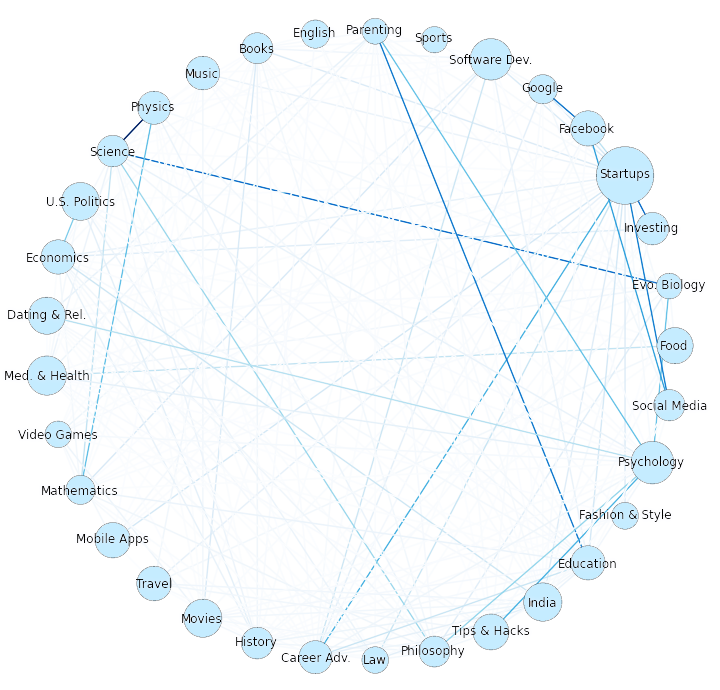
So how did Quora’s network come to be? According to the post, the team began constructing snapshots of questions asked from mid-2011 to today. A question was deemed “good” if at least two people pointed to it. From there, they simply counted how many of these questions pointed to a particular topic. You can see the graph that was plotted below:

Topic and Quality of high quality topics on Quora 730x381 Quora reveals the secret to how it organizes content and the most popular topics on its Q&A service

With 5,000 topics in its platform with at least 100 good questions, Quora says that this is nearly four times the number of topics back in 2011.

The blog post goes into a more detailed mathematical explanation and we’ll spare you from our explanation of it — you can read it in full here. However, the end result is that through its system, it has been able to visualize the largest 33 topics on its platform. Some of the more notable ones include startups, psychology, social media, medicine and health, tips and hacks, software development, parenting, US politics, and more.

Quora Topic Graph most popular topics and their relationships 1 Quora reveals the secret to how it organizes content and the most popular topics on its Q&A service

The point Quora wants to let you know is that it has been working to create a system that can handle a large, scalable topic hierarchy that’s forming in its database. It believes that over time, its topic structure will become more detailed and enable users to discover the “best and most relevant content”.

Photo credit: Scott Olson/Getty Images

└ Tags: syndicated
a couple of laughzillas on a blue diamond background

LinkedIn makes its biggest acquisition by paying $120m for job matching service Bright

Feb06
by Sindy Cator on February 6, 2014 at 10:17 pm
Posted In: Around the Web, Insider, linkedin, linkedin acquires bright, linkedin acquires bright $120 million

108847671 520x245 LinkedIn makes its biggest acquisition by paying $120m for job matching service Bright

LinkedIn has made its biggest acquisition deal to date today. The professional social network has purchased the job matching service Bright for $120 million, made up of 73 percent stock and 27 percent cash.After the deal closes in the first quarter of 2014, several members of Bright’s team will join LinkedIn, including its engineering and product divisions. Existing users will be able to access their data on Bright’s website through February 28.

Bright founder Eduardo Vivas said in a statement that the deal took place because “[LinkedIn] shares a similar vision and is equally obsessed about using data and algorithms to connect prospects and employers.” The one problem that Bright apparently lacked was the ability to scale. Yes, Vivas’ team had the talent in-house to build out its product and has successfully calculated billions of scores, but it didn’t have the ability to bring its technology to a much larger marketplace.

As Vivas puts it: “We may become less visible than we were before, but it’s now more likely than ever that you’ll feel the impact of our work.”

If you’re not familiar with Bright, it’s a service that utilizes machine-learning algorithms to recommend jobs to those looking for work. It also uses data-driven matching technology to make sure that users aren’t finding irrelevant listings.

The $120 million for Bright is the most LinkedIn has paid. Previous acquisitions include Slideshare, which cost $119 million, and Pulse, worth $90 million. It will be interesting to see Bright’s impact as LinkedIn continues to grow in terms of membership. As Re/code points out, Bright is a natural fit for LinkedIn as it makes a bulk of its revenue from its Talent Solutions group. Over the past couple of years, LinkedIn has made several updates and launched new features to improve the process for recruiters — Bright may kick things up a notch.

Photo credit: Justin Sullivan/Getty Images

└ Tags: syndicated
a couple of laughzillas on a blue diamond background

Dbrand skins add vinyl swagger to your favorite gadgets

Feb06
by Sindy Cator on February 6, 2014 at 9:58 pm
Posted In: Around the Web, Gadgets

ps4 dbrnad 1 520x245 Dbrand skins add vinyl swagger to your favorite gadgets

I’ve been curious about Dbrand’s 3M vinyl skins for a while now, but I could never get a solid sense of how they’d look in real life from just the images on the company’s website. After trying out sample skins for the PlayStation 4 and iPhone 5s, I have to say the results are impressive.

Dbrand’s texture choices include a carbon fiber weave, brushed titanium, leather, colorful powder-coated material and wood. We went with wood for the iPhone 5s and a gold and matte black combination for the PS4. We also tried out a white leather Moto X skin, but we don’t recommend it (more on that later).

ps4 dbrnad 2 520x346 Dbrand skins add vinyl swagger to your favorite gadgets
ps dbrand 3 520x346 Dbrand skins add vinyl swagger to your favorite gadgets

Other devices you can outfit with vinyl include Nexus smartphones and tablets, iPads, the PlayStation 3, Xbox 360, PlayStation Vita, HTC One, BlackBerry Z10 and the Galaxy S4. A full PS4 set of skins cost $45, while the Moto X and iPhone 5s versions cost $16 and $24, respectively.

The other factor holding me back from buying skins for my devices is the fear that I’d mess up the application. It takes a rare combination of patience and coordination to apply a skin or a screen protector without a few blemishes or air bubbles in the process.

Dbrand has a helpful series of video and photo directions on their site. I still managed to screw things up a bit, but the material tended to be forgiving. I ended up having to unpeel and reapply several of the pieces, but the end result turned out okay. If you’re willing to spend the extra time to go slowly and carefully line everything up, the skin really does fit perfectly.

Once applied, the mahogany skin looked and felt fantastic on the iPhone. However, the edges of the skin felt a tad sharp on the device when handling it, and I was slightly disappointed by a slight gap on the frame pieces that the product photos on the website didn’t show. The extra vinyl material also made the power button lose some of its travel; it’s only a minor annoyance, but still worth noting.

iphone dbrand 2 520x222 Dbrand skins add vinyl swagger to your favorite gadgets
iphone dbrand1 520x269 Dbrand skins add vinyl swagger to your favorite gadgets

I feel somewhat guilty putting faux-wood vinyl over Apple’s metal design, but that’s what makes it so cheeky. The look will get old after a while, but the $24 shouldn’t be too much of a setback if you’re the type of person who changes cases every few months.

Despite my fears that the gold PS4 would come across as over the top, it actually looked pretty good. Yes, it borders on ridiculous, but it does so with style. You can customize your color scheme for the top left, top right, bottom left and bottom right sections, as well as the controller. One caveat: I’d skip the gold-accented controller in the future, as it looked tacky and changed the feel of the controls .

As for the Moto X, I don’t see the point when you already have loads of color and accent options with the Moto Maker tool. The white leather skin turned out to be a poor choice, as it didn’t cover up the phone’s underlying color. The setup might look better on a plain-colored Moto X, but it just looked and felt tacky on mine.

motox dbrand 220x319 Dbrand skins add vinyl swagger to your favorite gadgets

From a product perspective, Dbrand’s skins live up to the hype. The company’s use of 3M’s vinyl makes it easy to handle, durable and it doesn’t leave a residue when you take it off.  However, when it comes to style, it’s up to you to pick the right one, as the results could turn out either awesome or awful.

└ Tags: syndicated
  • Page 14,584 of 14,636
  • « First
  • «
  • 14,582
  • 14,583
  • 14,584
  • 14,585
  • 14,586
  • »
  • Last »
The Daily Dose, The Daily Dose © 1996 - Present. All Rights Reserved.
  • Home
  • About
  • Archive
  • Books
  • Collections
  • Links
  • Shop
  • Submit a joke
  • Video
  • Privacy Policy