The Daily Dose

laugh every day with cartoons jokes and humor
  • Home
  • About
    • Press
      • Press Release – Announcing Laughzilla the Third ebook
      • Press Release – The Daily Dose Kicks Off Its 16th Year with New Books and More Irreverent Laughter
      • Press Release – Themes Memes and Laser Beams Now Available in Paperback
      • Press Release – Announcing Themes Memes and Laser Beams
      • In The News
    • Privacy
  • Archive
  • Books
  • Shop
  • Collections
    • Galleries
      • Gallery
      • Captions
      • Flash Cartoons & Greeting Cards
        • Laughzilla’s Oska Flash Animation Cartoon Greeting Cards
        • Oska Cupid Love Humor
    • #OccupyWallStreet
    • cats
    • China
    • Food
      • Hors d’oeuvres
        • Ball of Cream Cheese
      • Entrees / Main Courses
        • Meatballs with Baked Beans and Celery
    • Gadaffy
    • Google
  • Links
  • Video
  • Submit a joke
DeviantART Facebook Twitter Flickr pinterest YouTube RSS

Subscribe for Free Laughs!


Latest Comics

  • This Memorial Day, Trump Meme Coin Congratulates Profit Takers
  • 25 Years of The Daily Dose
  • The Best Cartoons
  • Bitcoin sings “Fly Me To The Moon”
  • 22 years of The Daily Dose

Comic Archive

Bad Recep-tion In Cairo

Daily Dose News Roundup

  • Crypto impersonation scams grew 1,400% as AI supercharged fraud
  • How AI is transforming frontend engineering for modern web applications
  • Armenia just opened the region’s biggest AI factory. It exists because Washington signed a licence.
  • Cloudflare built a browser for AI agents. It uses 7x less memory than Chromium and runs entirely on Workers.
  • Fusion’s best-funded bet raised another $1bn, and hired the banker who took Moderna public

Quotable

"With all the great delusional propaganda coming out of dictatorships these days, it seems like Baghdad Bob is making lots of money as a PR advisor." ~ Yasha Harari

Fresh Baked Goods

Get The Daily Dose's ebook: Laughzilla the Third - A Funny Stuff Collection of 101 Cartoons from TheDailyDose. Click here to get the e-book on Amazon kdp. Laughzilla the Third (2012) The Third Volume in the Funny Stuff Cartoon Book Collection Available Now.

Click here for the Paperback edition


Support independent publishing: Buy The Daily Dose's book: Themes Memes and Laser Beams - A Funny Stuff Collection of 101 Cartoons by Laughzilla from TheDailyDose. Click here to get the book on Amazon. Themes Memes and Laser Beams - The Second Volume in the Funny Stuff Cartoon Book Collection.

Click Here to get the book in Paperback While Available on Amazon

Themes Memes and Laser Beams - 101 Cartoons by Laughzilla. Get the e-book on Lulu.

Click Here to get The Daily Dose Cartoon ebook on amazon kindle

Funny Stuff :
The First Cartoon Book
from The Daily Dose.
Available on Lulu.

a couple of laughzillas on a blue diamond background

A new report sheds light on how the Chinese use their smartphones during Lunar New Year season

Feb18
by Sindy Cator on February 18, 2014 at 11:01 am
Posted In: Apps, Around the Web, Asia, Mobile Apps

shutterstock 124511842 520x245 A new report sheds light on how the Chinese use their smartphones during Lunar New Year season

Chinese New Year heralds in what’s known as the world’s largest annual migration, as people in the country start to make their way back to their hometowns. This means that despite official Chinese New Year holidays starting January 31 and ending February 6, the busiest period of the season takes place beforehand, starting from around January 16.

With 500 million mobile Internet users in China as of last year, any indicator of the way they spend their time on their smartphones is valuable for advertisers. How exactly did they behave during Chinese New Year?

AppFlood, a mobile advertising network run by China’s Papaya Mobile, has come up with a report that notes the average click volume on mobile ads between January 16 and February 6 was 51.5 percent higher than the period before January 16, suggesting that mobile usage increased during the holiday.

However, as far as app downloads were concerned, AppFlood notes that mobile users were more inclined to download apps before their long journeys back to their hometowns — so the highest rate of app installs happened just before January 16. Subsequently, the app install rate steadily decreased — declining an average of 1.37 percent day-over-day after January 16 up to February 6, making up a total slide of 28.7 percent.

AppFlood says this is because smartphone users who are not inclined to download apps when they are traveling, or when they are back in their hometowns out visiting at other people’s houses, as a stable Wi-Fi connection might be hard to come by.

The report’s results are based on a sample size of nearly 1.8 million unique active Android users in China during December 1, 2013 to February 6, 2014, an AppFlood spokesperson says. They were monitored based on the clicks and installs of ads within publishers’ apps based on AppFlood’s network of users in China.

According to AppFlood, messaging service WeChat was a “de facto app during the holidays” and “clearly was the forerunner,” but other top apps by percentage of daily average clicks were arcade games and productivity-related apps. Looking at the average daily volume of clicks on mobile ads between January 12 (when app install activity spiked) and February 6 (the end of the official Chinese New Year holidays), AppFlood notes that arcade games accounted for 9.55 percent of the total daily average clicks, becoming the most popular Android app category during the period. Entertainment apps followed after with 3.42 percent.
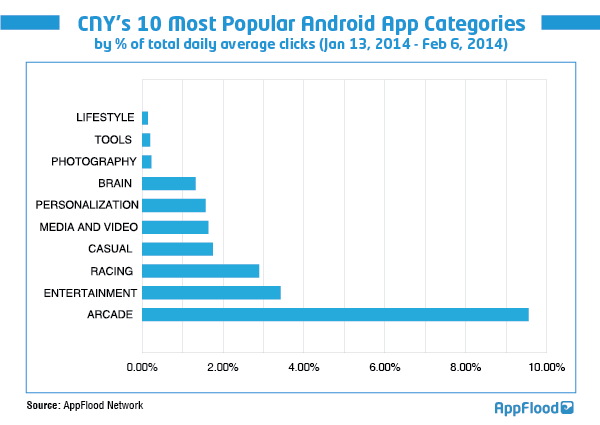
CNY10MostPopularAndroidAppCategories 01 A new report sheds light on how the Chinese use their smartphones during Lunar New Year season

As for app installs, productivity apps topped the charts based on average daily installs during the same period, accounting for 41.9 percent of total daily installs. Arcade games followed with 32.7 percent of total installs.
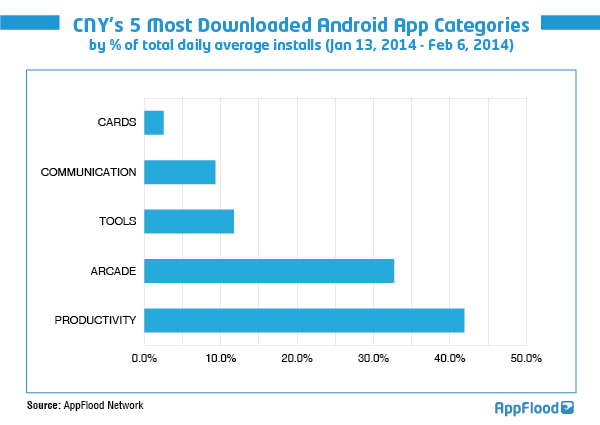
CNY5MostDLAndroidAppCategories 01 A new report sheds light on how the Chinese use their smartphones during Lunar New Year season

 AppFlood notes that the “Chinese New Year holiday is one of the rare opportunities for developers to pick up quality and affordable users — particularly during the days leading up to the Chinese New Year,” due to the growth in clicks during the season.

Comparing average mobile ad installs before and after January 10 — when app installs picked up pace before the peak travel period — AppFlood finds that mobile advertisers on average chalked up 121.9 percent more installs, the bulk of them happening before January 23.

Chinese New Year is looking to be a time for tech firms to garner more eyeballs from mobile users.

Chinese search giant Baidu launched a map illustrating the most popular migration paths, while messaging app WeChat brought Chinese New Year traditions into the mobile era by tapping into digital payments and letting users send monetary gifts in place of ‘red envelopes.’

Headline image via Bikeworldtravel / Shutterstock.com

└ Tags: china, news, syndicated
a couple of laughzillas on a blue diamond background

ZTE set to unveil 6-inch Grand Memo II LTE, new Firefox OS device and updated MiFavor UI at MWC 2014

Feb18
by Sindy Cator on February 18, 2014 at 10:18 am
Posted In: Around the Web, Gadgets, Insider, smartphones

As the world’s mobile makers, app developers and service companies ready themselves to make the trip to Barcelona for Mobile World Congress 2014, Chinese handset maker ZTE couldn’t resist giving a little taste of what it’s planning to unveil.

Among the line-up for ZTE’s MWC 2014, we’ll be seeing a new 6-inch phone-cum-tablet in the form of the Grand Memo II LTE and the ‘Open C’ – a fresh addition to its Firefox OS line-up running the newest version of the software. As well as unveiling the new devices, ZTE will also be showing off its MiFavor 2.3 UI, the most recent version of its custom interface.

Naturally, we’ll be on the ground to go hands-on with the latest and greatest devices to be announced, as well as taking a peek at some of ZTE’s other gadgets like the Grand Smart Watch too.

➤ ZTE Launches Dynamic New Handsets at Mobile World Congress 2014

Featured Image Credit – STR/AFP/Getty Images


└ Tags: news, syndicated
a couple of laughzillas on a blue diamond background

No longer just a clone factory, Rocket Internet has huge plans for global e-commerce

Feb18
by Sindy Cator on February 18, 2014 at 10:10 am
Posted In: Around the Web, Asia, lazada, rocket internet, zalora

rocket 520x245 No longer just a clone factory, Rocket Internet has huge plans for global e commerce

German technology incubator Rocket Internet is most commonly associated with being a clone factory that creates imitations of successful businesses, but its ambitious strategy in emerging markets is increasingly challenging that label.

While it is true that Rocket Internet ventures take their cues from existing companies, the organization has graduated from starting and growing businesses in the hope of making ‘quick’ money from acquisitions, to a different philosophy of building longer lasting, permanent entities.

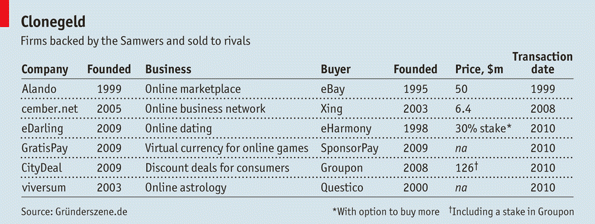
This chart from the Economist recaps the successful sales that the Samwer brothers, who own and run Rocket Internet, have overseen:

rocket internet 520x195 No longer just a clone factory, Rocket Internet has huge plans for global e commerce

Rocket Internet still pumps out a wide-variety of new companies that draw ‘inspiration’ from Silicon Valley success stories, but, as some of its early ventures mature, so the company is shifting to look at the long term for those that have made the grade. The organization remains ruthless about cutting business that aren’t performing or don’t show the requisite growth potential though — indeed, it pulled its entire operations in Turkey overnight in 2012.

Zalora IPO?

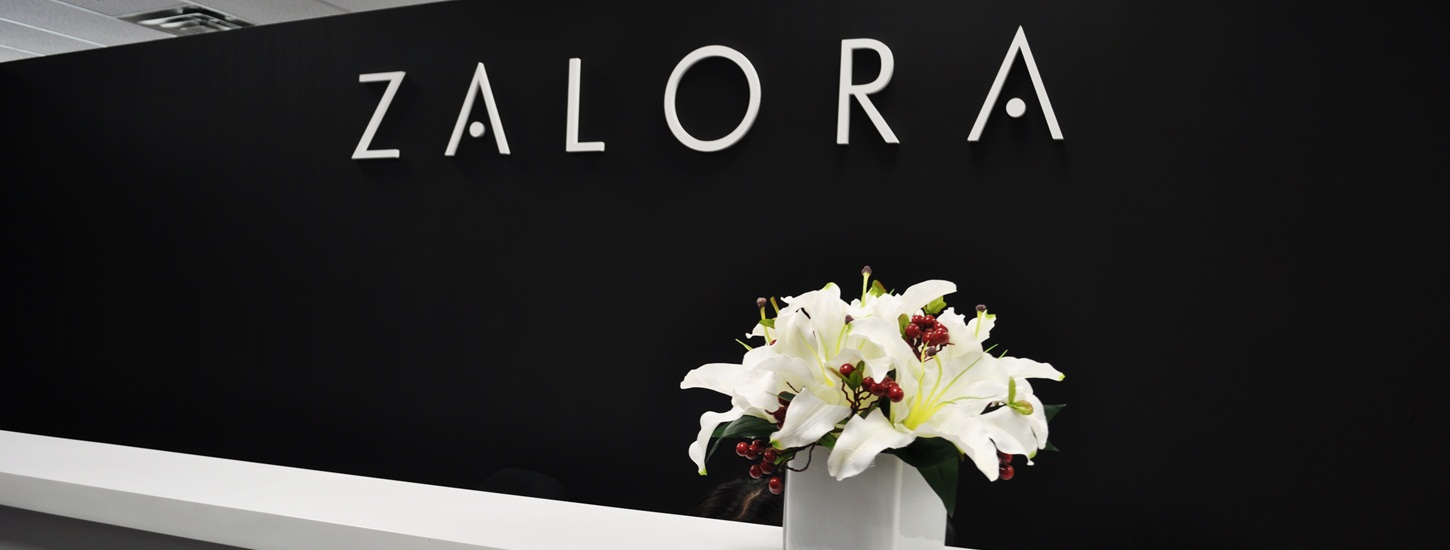
The shift in approach is most evident in Southeast Asia where a recent job ad indicates that Zalora, Rocket Internet’s online fashion retail business, is looking into a potential IPO in the US.

Zalora was launched in March 2012, and sells a range of fashion items from independent and global brands across eight markets in Southeast Asia — it covers New Zealand and Australia via a separate site, The Icon.

Alongside sister site Lazada, an Amazon-like site which began selling technology goods but has branched out into other items, Zalora is looking like the most promising venture within Rocket Internet’s portfolio. That assessment is made entirely on interest from investors, however, since neither site has disclosed financial figures.

ZALORA sign 730x276 No longer just a clone factory, Rocket Internet has huge plans for global e commerce

Money, money, money

Unlike past Rocket Internet ventures, which were built and quickly sold, Zalora and Lazada have gone past the point of being acquisition fodder for Amazon or other online retailers thinking of expanding their global footprint. That’s down to the numerous funding rounds and presumably high valuations for both businesses.

Here’s a potted history of their investment deals to date — it’s worth bearing in mind that these are funded by institutional investors, rather than regular tech-focused venture capitalists:

  • September 2012: Lazada raises “over” $50 million
  • September 2012: Zalora raises undisclosed round
  • November 2012: Lazada raises $40 million
  • December 2012: Lazada raises $26 million
  • January 2013: Lazada raises $20 million
  • March 2013: Zalora raises $26 million
  • May 2013: Zalora raises $100 million
  • June 2013: Lazada raises $100 million
  • December 2013: Zalora raises $112 million
  • December 2013: Lazada raises $250 million

That’s close to $750 million in less than two years. An incredible amount for anywhere in the world, let alone Southeast Asia, where traditional investment is comparatively scarce, to the point that corporate companies partake in startup fundraising.

It seems clear that Rocket Internet has different goals for Zalora and Lazada compared to its past initiatives. This time it is about building opportunities in green field regions where online retail is nascent and the top brands in the West are not present.

Both Zalora and Lazada anticipate profitability in 2015 so it makes sense that, having raised a lot of investment, a public listing could be a possible route to take – note: there is no evidence that Lazada is doing so, though the companies have followed similar cycles since launching.

There might yet be a bigger plan, however.

Plans to create international retail super-brands?

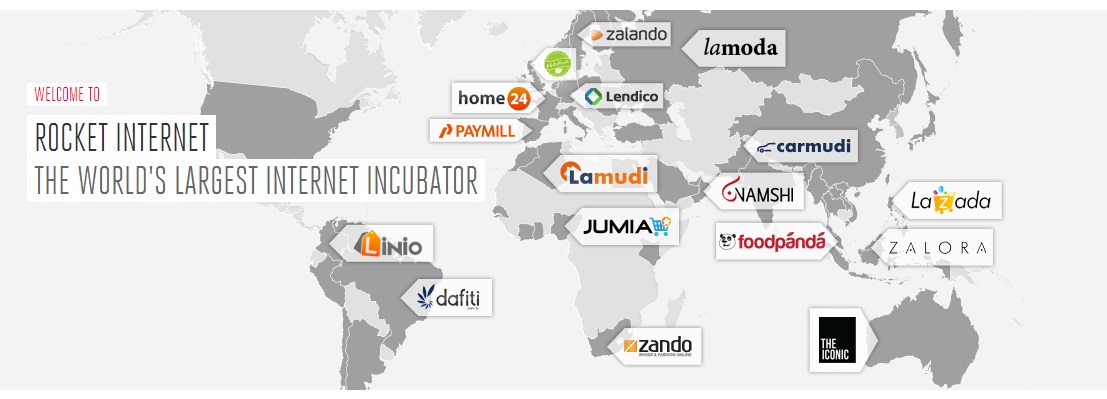
Rocket Internet and its investors haven’t just spent big in Southeast Asia. They’ve dished out major investments in e-commerce sites in Latin America, Russia, the Middle East and Africa — I was struck by the potential significance of a minor announcement last year that might just show a glimpse of what the company is planning overall for its e-commerce businesses.

Back in October 2013, Rocket Internet launched real estate platform Lamudi in an initial 12 countries across Asia, Africa and Latin America. The new site was actually a consolidation of different regional businesses, as we wrote at the time:

The launch of Lamudi sees Rocket Internet consolidate four different services — Vamido (Africa), Ubilista (Latin America), Zamudi and House (both Asia) — under one roof.

Could it be that there are plans to unite its business into huge entities? Rocket Internet is already using a ‘single brand for global business’ strategy with Uber rival EasyTaxi, FoodPanda and other businesses, so why not do the same for online retail?

Let’s recap what fashion retail businesses it has and where (there are also other Lazada-like businesses too):

  • Zalora: serves 8 (10 alongside The Icon) markets in Southeast Asia, has raised over $250 million
  • Lamoda: serves Russia and CIS, has raised over $140 million
  • Dafiti: serves 5 markets in Latin America, has raised over $220 million
  • Namshi: serves 6 markets in the Middle East, has raised over $30 million
  • Jumia: serves 6 markets in Africa, has raised over $30 million

If a united global brand is planned, then a Zalora IPO would suddenly make a great deal more sense.

Rather than floating a company with business that is operational in eight countries in Southeast Asia (a region not known for high consumer spending), it could unite the businesses in Africa, Europe, the Middle East, Latin America and Southeast Asia and float a genuinely global company.

That’s quite a number of ifs and buts and an IPO may not even occur – but the prospect of such an event shows just how far Rocket Internet has moved from its initial position as a clone factory.

We contacted Rocket Internet before publishing this article, but the company declined to comment on global plans for its e-commerce businesses. A Zalora spokesperson declined to comment on potential IPO plans when contacted by TNW.

rocketi 730x263 No longer just a clone factory, Rocket Internet has huge plans for global e commerce

Headline image via Vadim Sadovski / Shutterstock

└ Tags: europe, news, syndicated
a couple of laughzillas on a blue diamond background

No longer a clone factory, Rocket Internet has huge plans for global e-commerce

Feb18
by Sindy Cator on February 18, 2014 at 10:10 am
Posted In: Around the Web, Asia, lazada, zalora

rocket 520x245 No longer a clone factory, Rocket Internet has huge plans for global e commerce

German technology incubator Rocket Internet is most commonly associated with being a clone factory that creates imitations of successful businesses, but its ambitious strategy in emerging markets is increasingly challenging that label.

While it is true that Rocket Internet ventures take their cues from existing companies, the organization has graduated from starting and growing businesses in the hope of making ‘quick’ money from acquisitions, to a different philosophy of building longer lasting, permanent entities.

This chart from the Economist recaps the successful sales that the Samwer brothers, who own and run Rocket Internet, have overseen:

rocket internet 520x195 No longer a clone factory, Rocket Internet has huge plans for global e commerce

Zalora IPO?

Things are changing however. The shift in approach is most evident in Southeast Asia where a recent job ad indicates that Zalora, Rocket Internet’s online fashion retail business, is looking into a potential IPO in the US.

Zalora was launched in March 2012, and sells a range of fashion items from independent and global brands across eight markets in Southeast Asia — it covers New Zealand and Australia via a separate site, The Icon.

Alongside sister site Lazada, an Amazon-like site which began selling technology goods but has branched out into other items, Zalora is looking like the most promising venture within Rocket Internet’s portfolio. That assessment is made entirely on interest from investors, however, since neither site has disclosed financial figures.

ZALORA sign 730x276 No longer a clone factory, Rocket Internet has huge plans for global e commerce

Money, money, money

Unlike past Rocket Internet ventures, which were built and quickly sold, Zalora and Lazada have gone past the point of being acquisition fodder for Amazon or other online retailers thinking of expanding their global footprint. That’s down to the numerous funding rounds and presumably high valuations for both businesses.

Here’s a potted history of their investment deals to date — it’s worth bearing in mind that these are funded by institutional investors, rather than regular tech-focused venture capitalists:

  • September 2012: Lazada raises “over” $50 million
  • September 2012: Zalora raises undisclosed round
  • November 2012: Lazada raises $40 million
  • December 2012: Lazada raises 26 million
  • January 2013: Lazada raises $20 million
  • March 2013: Zalora raises $26 million
  • May 2013: Zalora raises $100 million
  • June 2013: Lazada raises $100 million
  • December 2013: Zalora raises $112 million
  • December 2013: Lazada raises $250 million

That’s close to $750 million in less than two years. An incredible amount for anywhere in the world, let alone Southeast Asia, where traditional investment is comparatively scarce, to the point that corporate companies partake in startup fundraising.

It seems clear that Rocket Internet has different goals for Zalora and Lazada compared to its past initiatives. This time it is about building opportunities in green field regions where online retail is nascent and the top brands in the West are not present.

Both Zalora and Lazada anticipate profitability in 2015 so it makes sense that, having raised a lot of investment, a public listing could be a possible route to take – note: there is no evidence that Lazada is doing so, though the companies have followed similar cycles since launching.

There might yet be a bigger plan, however.

Plans to create international retail super-brands?

Rocket Internet and its investors haven’t just spent big in Southeast Asia. They’ve dished out major investments in e-commerce sites in Latin America, Russia, the Middle East and Africa — I was struck by the potential significance of a minor announcement last year that might just show a glimpse of what the company is planning overall for its e-commerce businesses.

Back in October 2013, Rocket Internet launched real estate platform Lamudi in an initial 12 countries across Asia, Africa and Latin America. The new site was actually a consolidation of different regional businesses, as we wrote at the time:

The launch of Lamudi sees Rocket Internet consolidate four different services — Vamido (Africa), Ubilista (Latin America), Zamudi and House (both Asia) — under one roof.

Could it be that there are plans to unite its business into huge entities? Rocket Internet is already using a ‘single brand for global business’ strategy with Uber rival EasyTaxi, FoodPanda and other businesses, so why not do the same for online retail?

Let’s recap what fashion retail businesses it has and where (there are also other Lazada-like businesses too):

  • Zalora: serves 8 (10 alongside The Icon) markets in Southeast Asia, has raised over $250 million
  • Lamoda: serves Russia and CIS, has raised over $140 million
  • Dafiti: serves 5 markets in Latin America, has raised over $220 million
  • Namshi: serves 6 markets in the Middle East, has raised over $30 million
  • Jumia: serves 6 markets in Africa, has raised over $30 million

If a united global brand is planned, then a Zalora IPO would suddenly make a great deal more sense.

Rather than floating a company with business that is operational in eight countries in Southeast Asia (a region not known for high consumer spending), it could unite the businesses in Africa, Europe, the Middle East, Latin America and Southeast Asia and float a genuinely global company.

That’s quite a number of ifs and buts and an IPO may not even occur – but the prospect of such an event shows just how far Rocket Internet has moved from its initial position as a clone factory.

We contacted Rocket Internet before publishing this article, but the company declined to comment on global plans for its e-commerce businesses. A Zalora spokesperson declined to comment on potential IPO plans when contacted by TNW.

rocketi 730x263 No longer a clone factory, Rocket Internet has huge plans for global e commerce

Headline image via Vadim Sadovski / Shutterstock

└ Tags: europe, news, syndicated
a couple of laughzillas on a blue diamond background

Nouncy wants to shine a light on ‘Dark Social’ and replace email newsletters with simple Web pages

Feb18
by Sindy Cator on February 18, 2014 at 10:00 am
Posted In: Apps, Around the Web, Insider, Product Launches

Announcement 520x245 Nouncy wants to shine a light on Dark Social and replace email newsletters with simple Web pages

I don’t know about you, but I get a lot of email newsletters. And however many you get, I’d bet you don’t read half of them. Filter, delete, repeat.

While it’s not really too much of a hardship for me and thee, it’s a bit of a pain for the companies that spend time and money sending out their news only to have it sat lying unread in an inbox or deleted unopened.

However, not only are people reading fewer and fewer newsletters, traditional methods of getting your message out there aren’t tightly knitted together with today’s social take on tech either. And it’s easier to miss them than ever with services like Gmail now specifically filtering newsletters out of your main inbox.

Sick of the problem, Stef Gallé, founder of Smart.pr and now Nouncy, a Web platform for announcements, explained to TNW how his latest venture came to life:

We got frustrated by email newsletters. Open rates are dropping and they still look like they did in 1995, and most of all they completely ignore the social networks of the people around you, the people in your organisation.

We think everyone around you has fully developed social networks, but when a company announces news they don’t really use those networks.

Enter Nouncy

Launching today, the first version will let users create their own Nouncy on the homepage without creating an account or logging in, although you’ll need to create a free account if you want to actually publish it. Still, that’s not much of a hardship – Nouncy is free for now, and for the foreseeable future until the team has pinned down exactly who they want to target first-and-foremost.

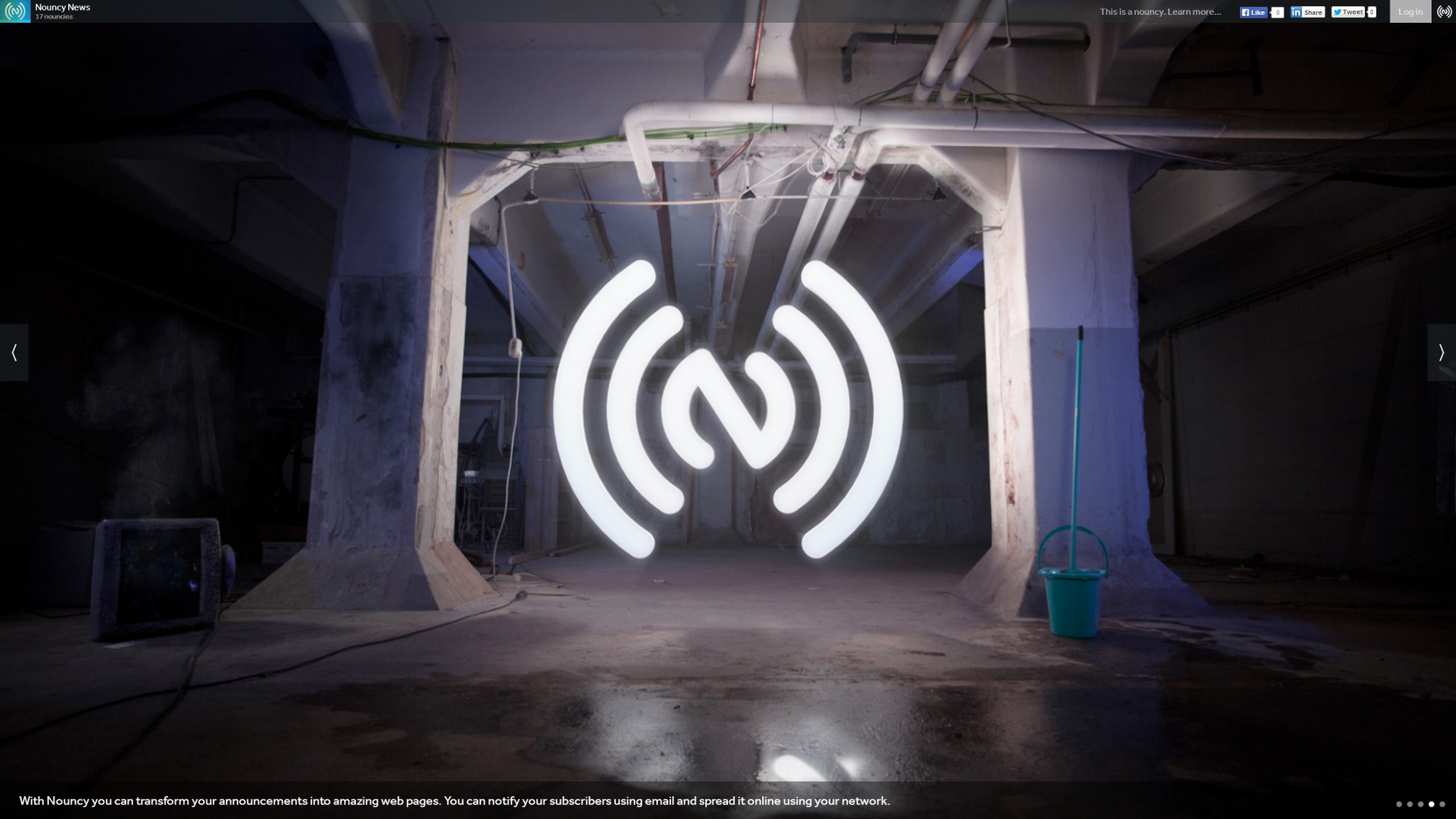
The process of creating your Nouncy is easy, and achieved using a simple online editor – “inspired by Medium, but it’s maybe even simpler”, Gallé tells us. Then all you need to do is invite your work network and publish it. The idea is that spreading the Nouncy can happen directly via employees, across social channels and in email bulletins. So Nouncy doesn’t want to kill email notifications altogether, just the long boring ones that no one reads.

Instead of static emails, you get parallax backgrounds, full screen slideshows and a responsive Web design that scales to any browser or device.

Nouncy news 730x410 Nouncy wants to shine a light on Dark Social and replace email newsletters with simple Web pages

The key idea is that for an announcement to have any kind of substantial effect, there needs to be a lot of buzz around it in a short space of time. The company hopes that by leveraging people’s existing relationships on social networks – and combining it with traditional marketing techniques like email – it will be able to achieve this.

Email is just one channel, there are a lot of channels that people consume news through these days, and to get relevant on those other channels – whether that’s LinkedIn or Facebook or Twitter – you have to get a group of people to talk about it in a short period of time, and that’s our goal. Without knowing it, a lot of people have these valuable networks but don’t use [them].

To really get people talking, it has to look good, it has to have a good narrative and take people through the story, and then get a group of people to talk about it.

It’s an idea that’s not too dissimilar from our own recently updated TNW Labs creation Spread.us.

In a future update, a company will be able to share a Nouncy with its employees and allow them to schedule status updates for social networks, then when the Nouncy is published all the social networks are updated automatically – an internal Buffer-like feature for announcements, essentially. Presumably, those employees will get a say in whether they want to announce the news via their own personal social channels.

Gallé says that Nouncy could also help shine a light on ‘Dark Social’ – the spread of news through channels like Google Chat, Direct Messages on Twitter and things like LinkedIn messages – too. “That’s all social interaction that’s not visible from the outside,” he tells us.

Nouncy 2 730x410 Nouncy wants to shine a light on Dark Social and replace email newsletters with simple Web pages

For now, however, Nouncy is still in experimentation mode and open to seeing which use cases best fit the platform. For example, when quizzed over whether Nouncy lends itself to more image-heavy bulletins than, say, a detailed tech announcement Gallé said there are plans to test a text-oriented template, but also plans to launch a video platform aimed at musicians and DJs.

We’re testing two templates right now, they’re both pretty image heavy but we want to add a text-based template pretty soon, but the idea is we want to show the advantages of web pages over email… But we’re moving towards templates that are simpler too, on one side. On the other, we want to add full screen video templates and audio templates for DJs who want to announce their new live set or bands that want to announce their new single.

That’s future-gazing for now, though. As of today, Nouncy is in open beta and ready for business. Gallé expects it to be used for things like announcing new features, monthly deals or perhaps even for recruitment – the most interesting job candidates often come from existing employees’ networks. In a few months, he says Nouncy will examine the use cases and decide what it wants to be best at. It’s admirable that Nouncy is not choosing to monetize via a traditional press release model, which would be the easiest route right now, but could dictate its future course and development.

To get to this point, Nouncy started work in the summer of 2013 and set about running a small private beta. It was the feedback from this that led the company to focus on trying to leverage the social aspect of announcements.  To date, while the company is just getting going, it has managed to secure €100,000 of pre-seed funding from Vitulum Ventures, Floris Rost van Tonningen and Maarten Beucker Andreae.

Nouncy isn’t occupying a unique space by any means. There are plenty of online flyer-type platforms (Smore, for example) and social impact tools like Thunderclap, but Gallé hopes that by bringing email newsletters into the next generation and combining tools like these, Nouncy will prove a valuable tool, whoever the target audience ends up being.

And, naturally, what more fitting a way is there for Nouncy to announce its public beta than by creating its own Nouncy.

Featured Image Credit – Shutterstock

└ Tags: news, syndicated
  • Page 14,525 of 14,660
  • « First
  • «
  • 14,523
  • 14,524
  • 14,525
  • 14,526
  • 14,527
  • »
  • Last »
The Daily Dose, The Daily Dose © 1996 - Present. All Rights Reserved.
  • Home
  • About
  • Archive
  • Books
  • Collections
  • Links
  • Shop
  • Submit a joke
  • Video
  • Privacy Policy